



[Event Preview] MSD Research Seminar Series- “Observing RNA Biology at Work in Human Tissues”
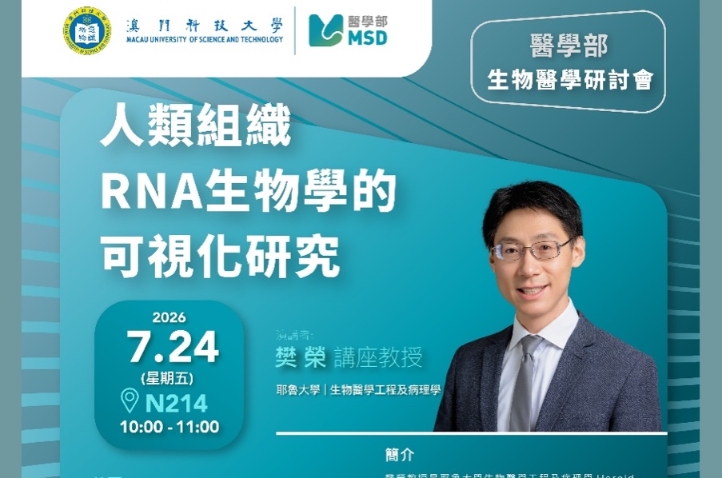
Date: 24th July 2026 (Friday)
Time: 10:00 – 11:00
Venue: N214
Theme: MSD Research Seminar Series- “Observing RNA Biology at Work in Human Tissues”
Language: English
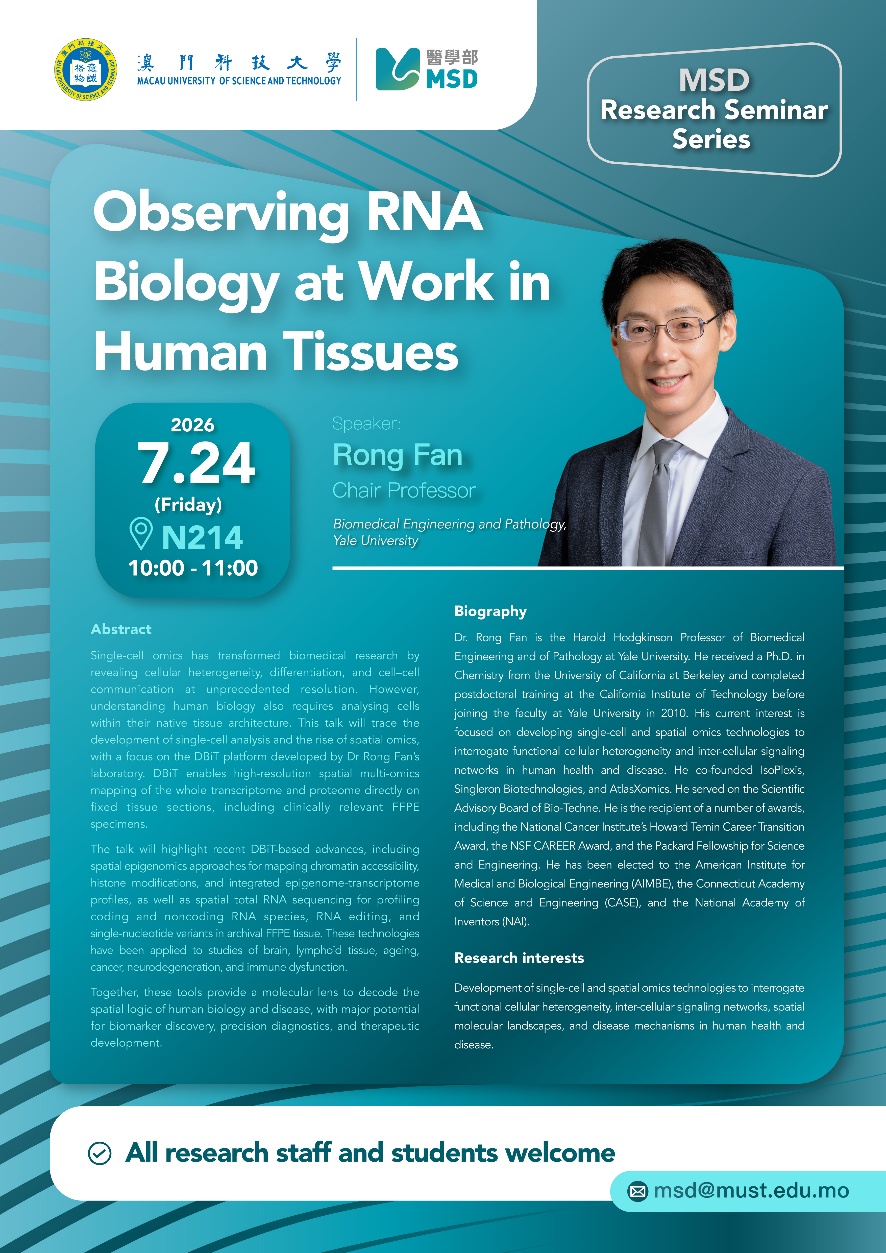
Speaker’s Biography
Dr. Rong Fan is the Harold Hodgkinson Professor of Biomedical Engineering and of Pathology at Yale University. He received a Ph.D. in Chemistry from the University of California at Berkeley and completed postdoctoral training at the California Institute of Technology before joining the faculty at Yale University in 2010. His current interest is focused on developing single-cell and spatial omics technologies to interrogate functional cellular heterogeneity and inter-cellular signaling networks in human health and disease. He co-founded IsoPlexis, Singleron Biotechnologies, and AtlasXomics. He served on the Scientific Advisory Board of Bio-Techne. He is the recipient of a number of awards, including the National Cancer Institute’s Howard Temin Career Transition Award, the NSF CAREER Award, and the Packard Fellowship for Science and Engineering. He has been elected to the American Institute for Medical and Biological Engineering (AIMBE), the Connecticut Academy of Science and Engineering (CASE), and the National Academy of Inventors (NAI).
Research interests
Development of single-cell and spatial omics technologies to interrogate functional cellular heterogeneity, inter-cellular signaling networks, spatial molecular landscapes, and disease mechanisms in human health and disease
Seminar Introduction
Single-cell omics has transformed biomedical research by revealing cellular heterogeneity, differentiation, and cell–cell communication at unprecedented resolution. However, understanding human biology also requires analysing cells within their native tissue architecture. This talk will trace the development of single-cell analysis and the rise of spatial omics, with a focus on the DBiT platform developed by Dr Rong Fan’s laboratory. DBiT enables high-resolution spatial multi-omics mapping of the whole transcriptome and proteome directly on fixed tissue sections, including clinically relevant FFPE specimens.
The talk will highlight recent DBiT-based advances, including spatial epigenomics approaches for mapping chromatin accessibility, histone modifications, and integrated epigenome-transcriptome profiles, as well as spatial total RNA sequencing for profiling coding and noncoding RNA species, RNA editing, and single-nucleotide variants in archival FFPE tissue. These technologies have been applied to studies of brain, lymphoid tissue, ageing, cancer, neurodegeneration, and immune dysfunction.
Together, these tools provide a molecular lens to decode the spatial logic of human biology and disease, with major potential for biomarker discovery, precision diagnostics, and therapeutic development.
Students who are interested should register on WeMust-Event.
All research staff and students are welcome to attend this seminar.
For more inquiries, please contact (853) 8897 3411 or email [email protected]