

MUST Successfully Hosts 2026 International Forum on Space and Planetary Sciences


MUST Successfully Hosts 2026 International Forum on Space and Planetary Sciences
The Forum was jointly organized by MUST, Shandong University and the Association for Promotion of Science and Technology of Macau; and hosted by MUST’s State Key Laboratory of Lunar and Planetary Sciences, and the Space Science Institute. Co-organized by the Macao Science Center. The forum was sponsored by the Macao Foundation and further supported by the Macau Science and Technology Development Fund. The event attracted more than 300 scholars in the fields of space and planetary sciences from over ten countries and regions, including the United States, Canada, France, Japan, Romania, Germany, Finland, Sweden, South Korea, Mainland China, Hong Kong, Macao, and Taiwan. Drawing more than 300 scholars from over ten countries and regions, the forum established a premier platform for high-level international exchange in space and planetary sciences.
The opening ceremony was attended by: Mr. Li YongXian, Deputy Director-General of the Department of Education and Youth Affairs of the Liaison Office of the Central People's Government in Macao Special Administrative Region; Mr. Guo Xiaofeng, Director of the Department of International Organizations and Legal Affairs of the Office of the Commissioner of the Ministry of Foreign Affairs of the People’s Republic of China in the Macao Special Administrative Region; Mr. Cheang Kun Wai, Member of the Administrative Committee of the Macao Science and Technology Development Fund; Mr. Chan Chou Weng, Deputy Director of Economic and Technological Development Bureau of Macao SAR Government; Mr. Chan Iok Wai, Head of the Department of Students of the Education and Youth Development Bureau of Macao SAR Government; Mr. Chui Sai Peng, President of the Association for Promotion of Science and Technology of Macau. Professor Ip Wing Huen, Chair of the Macao International Forum on Space and Planetary Sciences; Mr. Sio Hon Pan, Curator of the Macao Science Center; Professor Xia Lidong, Vice President of Shandong University (Weihai); Professor Sami Solanki, Director of the Max Planck Institute for Solar System Research in Göttingen, Germany; Macau University of Science and Technology representatives including Chair Professor Zhu Jian-Kang, President of MUST; Chair Professor Chen Yong, Vice President of MUST; Professor Xu Aoao, Retired President of Macao University of Science and Technology and Chief Supervisor of the Association for Promotion of Science and Technology of Macao; Chair Professor Zong Qiugang, Director of the State Key Laboratory of Lunar and Planetary Sciences and the Space Science Institute. Along with many other experts and scholars in the field of space and planetary science.
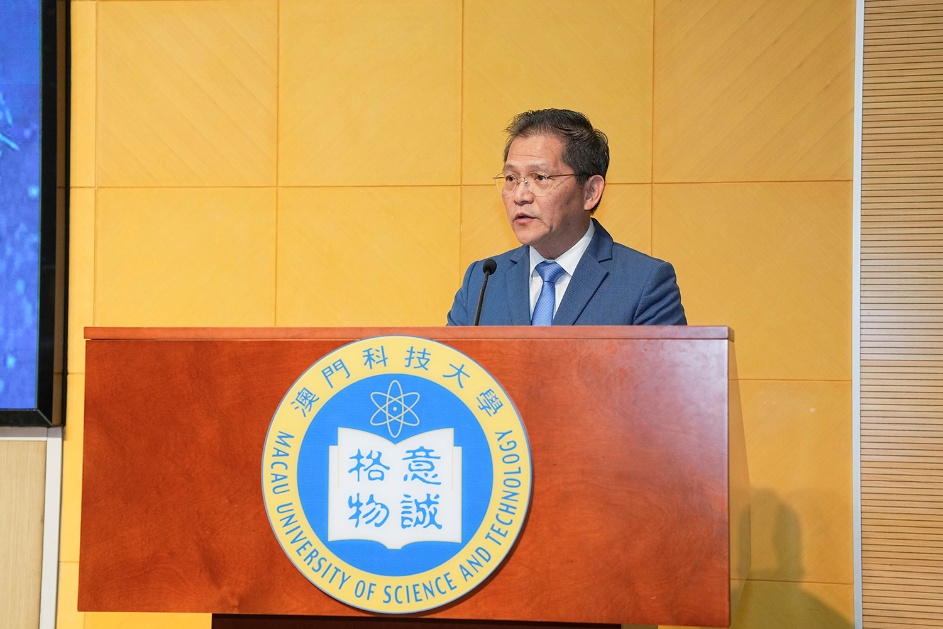
Speech by Mr. Cheang Kun Wai, Member of the Administrative Committee of the Macao Science and Technology Development Fund
Mr. Cheang extended a warm welcome to leading global experts in space and planetary sciences. He noted that the forum focuses on frontier topics in space science such as planetary exploration and lunar surface studies, aiming to build a high-level international platform for academic exchange. The Macao Science and Technology Development Fund has long been committed to promoting local scientific innovation and interdisciplinary collaboration, in order to facilitate Macao’s active participation in global scientific development trends, particularly in space science. As human understanding of the universe continues to deepen, space exploration increasingly relies on international cooperation and technological advancement. The Fund looks forward to countries and regions working together to seize opportunities, address challenges, and promote scientific innovation through pragmatic cooperation, injecting new momentum into global deep-space exploration.
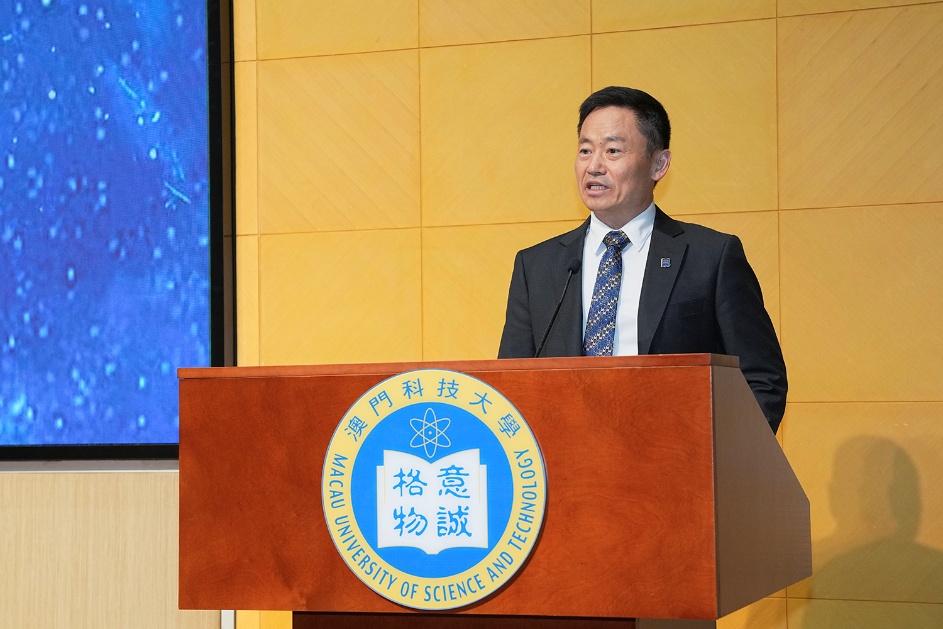
Speech by Chair Professor Zhu Jian-Kang, Vice-Chancellor and President of Macau University of Science and Technology
President Zhu noted that MUST has long been at the forefront of advancing space and planetary sciences, bringing together leading experts in global space research. The State Key Laboratory of Lunar and Planetary Sciences has been deeply involved in China’s Chang’E and Tianwen deep-space exploration missions, achieving numerous key breakthroughs in space and planetary science.
This Forum aims to leverage Macao’s role as a key hub for China’s aerospace and deep-space research, strengthen exchanges and cooperation between China and the international planetary science community, inspire young scholars to engage in space science research, open new horizons for deep-space exploration, and foster a new landscape for global research collaborations in the field.
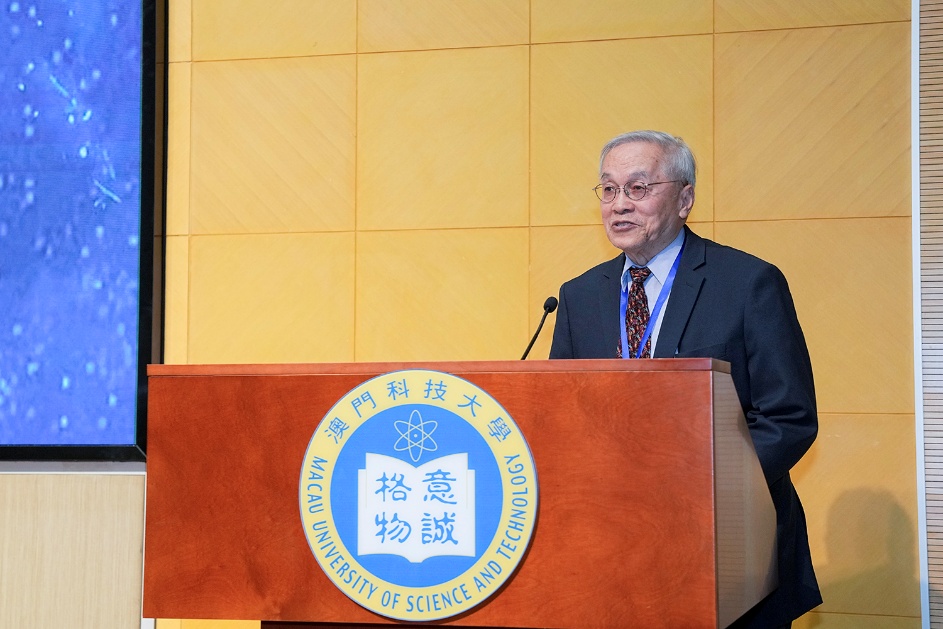
Speech by Ip Wing Huen, Chair of Macao International Forum on Space and Planetary Science
Professor Ip Wing Huen warmly welcomed experts and scholars from around the world. He shared the academic and peace philosophy of his mentor, Professor Hannes Alfvén.; and he emphasized that science needs rational foresight, ethical responsibility, and honest communication. He concluded by advocating international cooperation and wishing the forum success and all participants a pleasant stay in Macao.
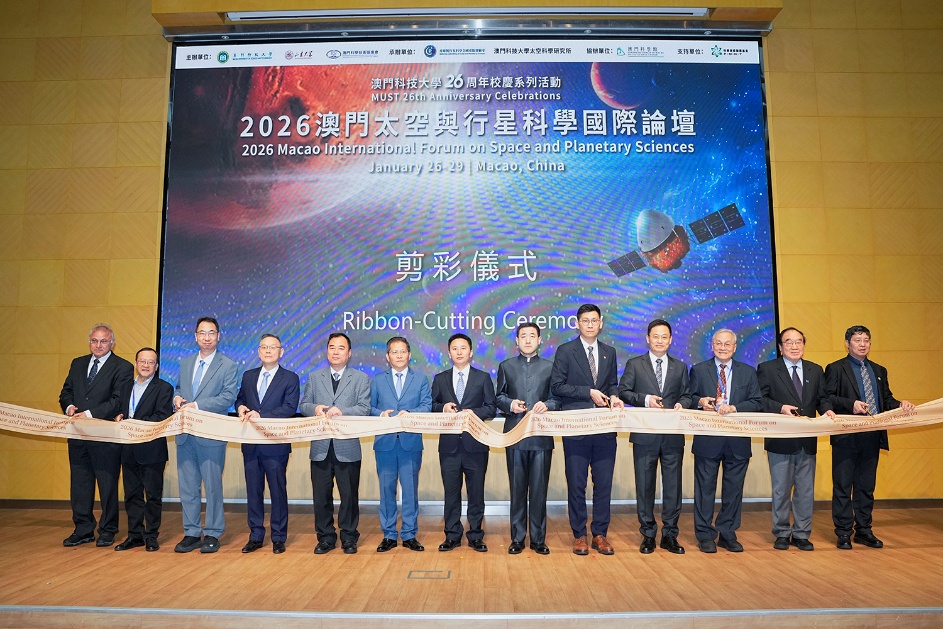
Ribbon-cutting ceremony at the Forum opening
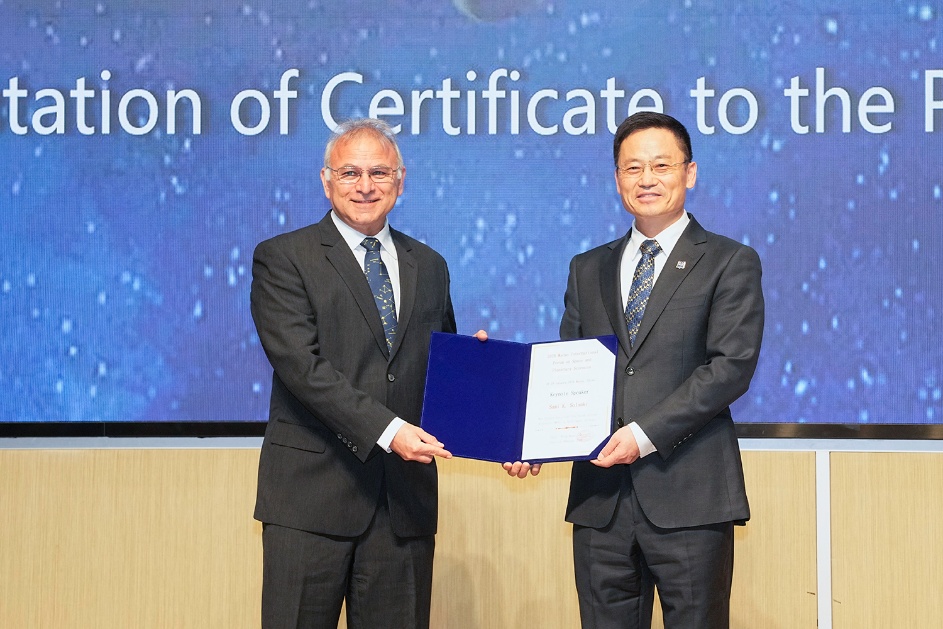
President Zhu presents the Conference Speaker Certificate to Professor Sami Solanki
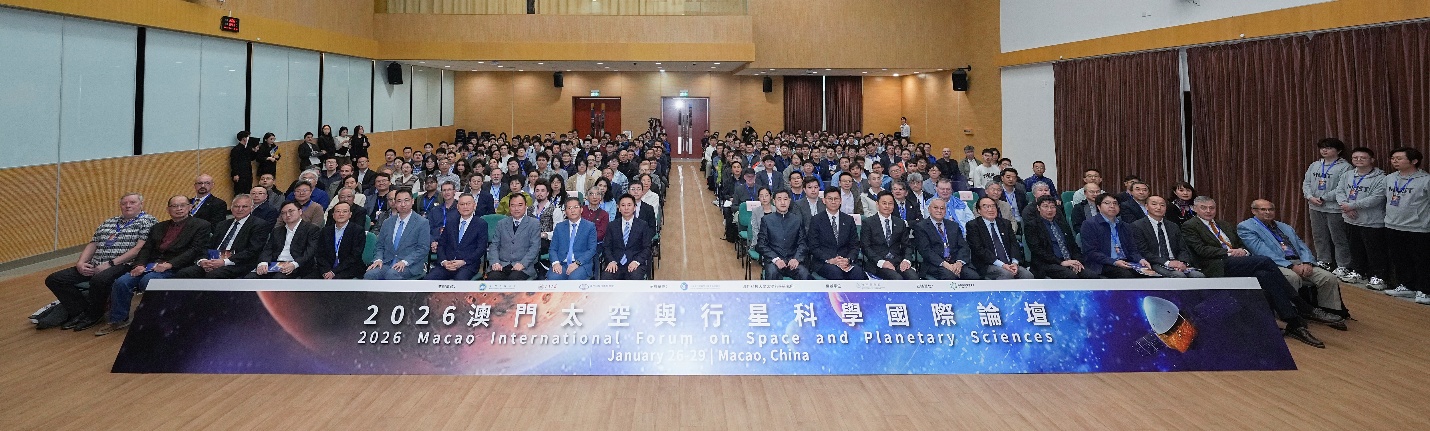
Group photo of the Forum opening ceremony
Following the opening ceremony, the scientific sessions of the Macao International Forum on Space and Planetary Science were held at the Macao Science center.
The Forum covered multiple frontier areas in space physics and planetary science. Through a series of insightful scientific presentations and thematic discussions, it provided participants with opportunities to broaden their perspectives, deepen their understanding, and enhance international academic exchange and collaboration.
By bringing together leading experts in space and planetary sciences worldwide, the Forum provided an open platform for researchers from diverse backgrounds to engage in dialogue, encourage experience sharing and intellectual exchange, stimulate innovative thinking, and promote coordinated development of future research.
Furthermore, the Forum laid a foundation for establishing long-term international cooperation mechanisms, facilitating deeper exchanges between China and the global planetary science community, and accelerating progress in China’s deep-space exploration and related disciplines. It is hoped that this event will inspire more young people to pursue scientific exploration, injecting sustained momentum into the diversified development of Macao and the national space program.