

Researchers from Macau University of Science and Technology and National Space Science Center reveal the lunar limb compression caused by the core-induced magnetic field.




Researchers from Macau University of Science and Technology and National Space Science Center reveal the lunar limb compression caused by the core-induced magnetic field.
Doctoral student Siqi Yi and Professor Xiaojun Xu from the State Key Laboratory of Lunar and Planetary Sciences at Macau University of Science and Technology, in collaboration with Researcher Lianghai Xie and Researcher Lei Li from the State Key Laboratory of Solar Activity and Space Weather, National Space Science Center, Chinese Academy of Sciences, have, for the first time, identified a new physical mechanism by which the induced magnetic field of the lunar core generates lunar limb compression through three-dimensional numerical simulations. This finding overturns the traditional view that this phenomenon is solely caused by lunar crustal magnetic fields and offers a new perspective on the interaction between the Moon and the solar wind. The results have recently been published in the international journals The Astrophysical Journal and Monthly Notices of the Royal Astronomical Society.
As Earth’s closest celestial neighbor, the Moon is a key target for deep-space exploration and planetary science research. A distinctive phenomenon known as lunar limb compression exists in the near-lunar environment, characterized by significant enhancements in plasma density and magnetic field strength outside the lunar wake. Previous studies have generally attributed this phenomenon to the deflection of the solar wind by localized crustal magnetic fields.
Taking a novel approach, the research team focused on the interaction between the Moon’s conductive core and the interplanetary magnetic field. Through three-dimensional, time-dependent magnetohydrodynamic simulations, they found that when the interplanetary magnetic field undergoes sudden changes, electric currents are induced within the highly conductive lunar core, generating an induced magnetic field. The superposition of this induced field with the external magnetic field creates magnetic pressure gradients near the lunar terminator, driving plasma motion and ultimately forming compression structures of both magnetic field and plasma outside the lunar wake.
The study further reconstructs the full evolution process of lunar limb compression: after the magnetic field disturbance reaches the vicinity of the Moon, induced currents are rapidly produced within the core; as these currents and the induced magnetic field intensify, lunar limb compression becomes increasingly pronounced; subsequently, as the induced field weakens, the compression structure gradually dissipates. The team also demonstrates that a larger core radius and higher electrical conductivity lead to a more significant lunar limb compression.
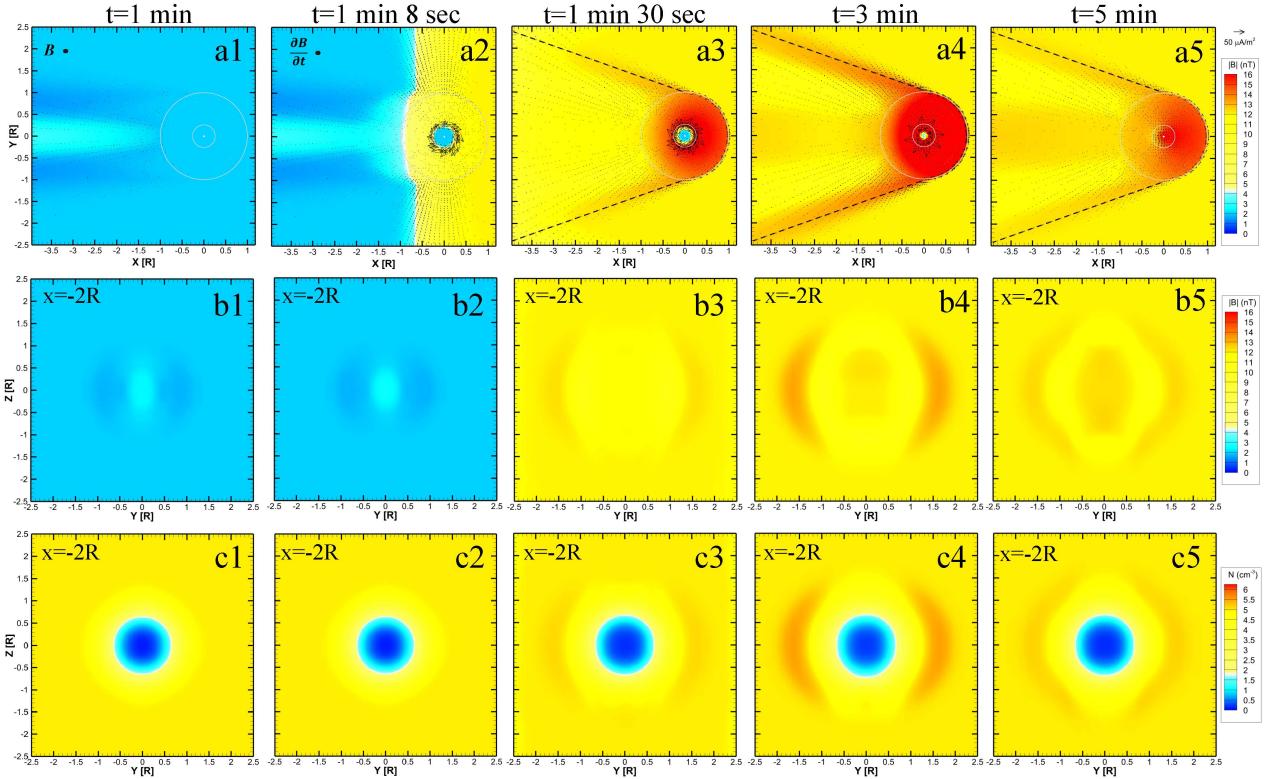
Figure 1. Dynamic evolution of compression signatures of the magnetic field and plasma number density in different planes.
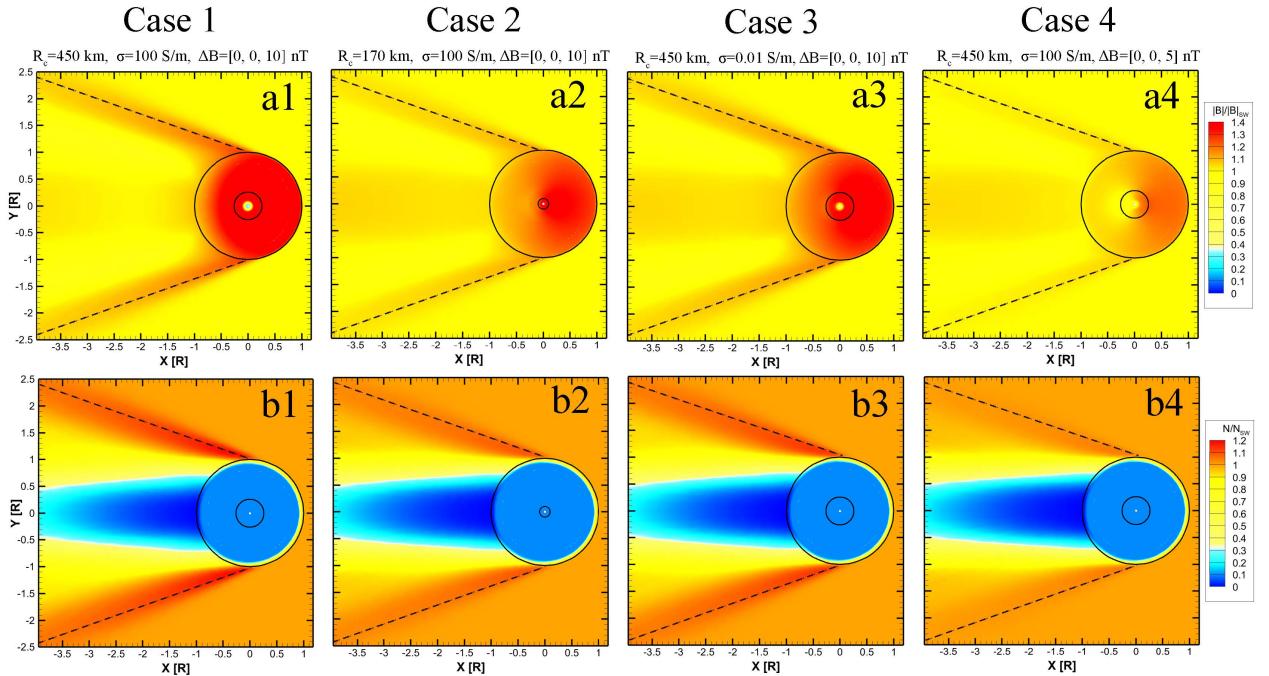
Figure 2. Comparison of the lunar interior induced response and lunar limb compression under different lunar core radii, electrical conductivities, and magnitudes of magnetic field variations.
This study elucidates the complete mechanism by which the induced magnetic field of the lunar core drives lunar limb compression and demonstrates the important role of the Moon’s conductive core in solar wind-Moon interactions. It fills a critical gap in our understanding of the lunar plasma environment and provides key theoretical support for future investigations of the Moon’s internal structure.
This work was supported by the National Natural Science Foundation of China, the Science and Technology Development Fund of Macao SAR, the Pandeng Program of the National Space Science Center, and the Youth Innovation Promotion Association of the Chinese Academy of Sciences.
The results have attracted significant attention from mainstream media. Science and Technology Daily featured the study prominently on its front page, while platforms such as the CCTV News app also reported on the findings. In addition, authoritative public platforms including the Chinese Society of Space Research (CSSR), Voice of CAS, and the National Space Science Center widely disseminated the results, generating strong academic and societal impact.