

Academician Vivian Wing-Wah Yam Talks about “From Molecular Design to Supramolecular Assembly, Nanostructures and Functional Properties for Applications in Energy, Materials and Biomedical Applications” at MUST


Academician Vivian Wing-Wah Yam Talks about “From Molecular Design to Supramolecular Assembly, Nanostructures and Functional Properties for Applications in Energy, Materials and Biomedical Applications” at MUST
The "Master of Science and Technology" lecture series titled "From Molecular Design to Supramolecular Assembly, Nanostructures and Functional Properties for Applications in Energy, Materials and Biomedical Applications" hosted by the Macau University of Science and Technology was successfully held in the Lecture Hall of Building D of MUST on the afternoon of Wednesday, April 16, 2025. This lecture invited Academician Vivian Wing-Wah Yam, a member of the Chinese Academy of Sciences, Vice President of The University of Hong Kong, and a renowned inorganic chemist, as the keynote speaker. Before the lecture began, Chair Prof. Joseph Hun-wei Lee, Vice Chancellor and President of MUST, delivered a speech and presented an appointment letter and souvenir to Academician Vivian Wing-Wah Yam.
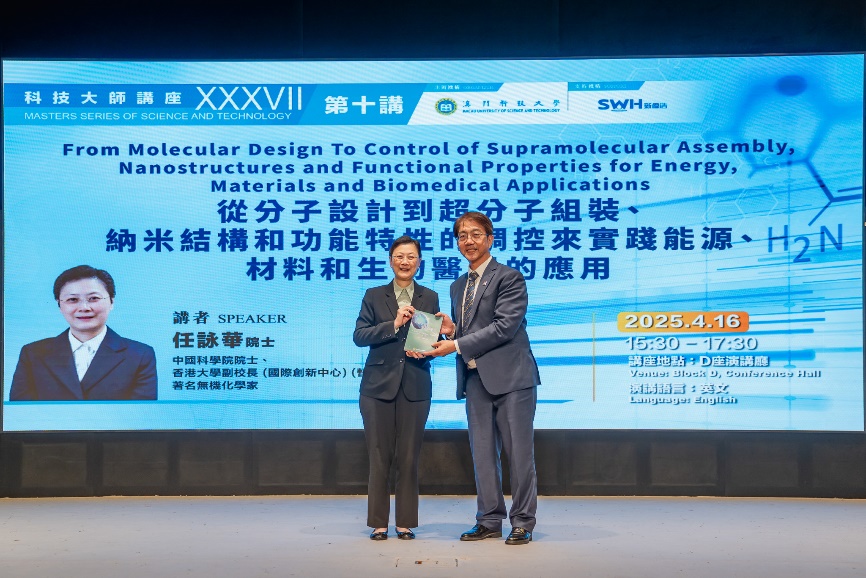
President Joseph Hun-wei Lee presenting souvenir to Academician Vivian Wing-Wah Yam
At the beginning of the lecture, Academician Vivian Wing-Wah Yam introduced the theme of today's lecture by referring to the electricity usage in daily life. She briefly introduced that photocatalysis technology mimics photosynthesis that uses light to drive redox reactions, demonstrating great potential in various applications. Academician Yam elaborated the applications of photocatalysis technology in the following two main fields. In the energy field, this technology can split water into hydrogen and oxygen. When hydrogen burns, only water is produced, forming a green closed-loop energy cycle. In addition, one can also convert carbon dioxide into useful petrochemical products, contributing to the solving of energy and environmental problems. In the medical field, photodynamic therapy brings new hope for cancer treatment. Through the preparation of photosensitive materials, reactive oxygen species such as singlet oxygen are generated under light irradiation, which can precisely kill cancer cells, suitable for patients especially with superficial cancers such as skin cancer and nasopharyngeal cancer. In addition, luminescent materials have also shown great potential in bioimaging and biolabeling, guiding surgeons to remove cancerous tissues more precisely and thus reducing damage and unnecessary removal of normal tissues.
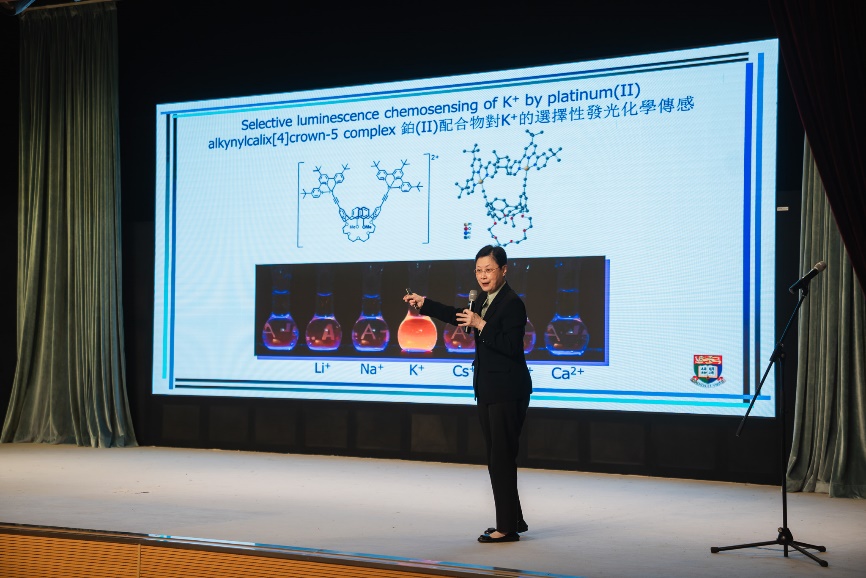
Academician Vivian Wing-Wah Yam
Afterwards, Academician Yam elaborated on the research in molecular assembly and control of functional properties of materials. The research focuses on precisely regulating molecular arrangements and properties by controlling the weak interactions between molecules. Taking platinum-containing compounds as an example, changing the ligands can render the complexes emissive in room temperature in solutions and exhibit different colors. It can also selectively detect specific ions, which is used for bioimaging and monitoring of physiological processes. Furthermore, different arrangements of flat molecules driven by metal−metal interactions can significantly affect the color and optical properties of the materials. By changing the solvent compositions or temperature, the distances and intermolecular interactions between molecules can be modulated, achieving changes in the colors and emission colors of the solution. She also introduced her brightly emissive gold-containing compounds for OLED applications. These achievements have brought new breakthroughs to the fields of energy, materials, and biomedicine.
During the Q&A session, a student asked when platinum-containing materials would be applied in our real lives. Academician Yam pointed out that her team has already developed the relevant materials and hoped to achieve wider applications in the future. At the same time, Academician Yam encouraged everyone to study seriously both in terms of the depth and the breadth, and generate new ideas through broad-based learning regardless of their research interest. Another student asked about photoinduced charge transfer. Academician Yam explained that electrons are transferred from the metal to the ligand upon light excitation, with the involvement of charge separation in the process that may lead to photoconductivity.
The lecture is sponsored by SWH Import and Export Company Limited.