

Macau University of Science and Technology Signs Memorandum of Understanding with Brazil’s IPEN—Joint Sino-Brazilian Nuclear Energy Research to Advance via Alpha-E Device


Macau University of Science and Technology Signs Memorandum of Understanding with Brazil’s IPEN—Joint Sino-Brazilian Nuclear Energy Research to Advance via Alpha-E Device
June 29, 2026 – Macau University of Science and Technology (MUST) signed a Memorandum of Understanding (MOU) with Brazil’s Institute of Energy and Nuclear Research (IPEN). Relying on MUST’s State Key Laboratory of Lunar and Planetary Sciences (SKLPlanets), the Alpha-E device—the world’s first desktop-scale miniature fusion research and teaching device developed by Alpha Ring International, a portfolio firm of WI HARPER Group—will be introduced under this collaboration. The two parties will also jointly apply for joint research funding under the FDCT‑FAPESP program to carry out cross‑border collaborative nuclear energy studies. This milestone marks a major leap forward for Macao in building a frontier research corridor linking the Guangdong‑Hong Kong‑Macao Greater Bay Area (GBA) and Portuguese‑speaking nations. It also supports China’s 15th Five‑Year Plan fusion energy strategy, cementing MUST’s leading standing in global nuclear energy education and technology outreach.
The signing ceremony was held in hybrid format at MUST. Professor Xiaoping Zhang, Deputy Director of the State Key Laboratory of Lunar and Planetary Sciences, signed the document in person on behalf of MUST, while Professor Isolda Costa, lead representative of Brazil’s IPEN, signed remotely. Chair Professor Yong Chen, Vice President of MUST, witnessed the event online, and Dr. Kwan Wong, Chairman of WI HARPER (MACAU) INVESTMENT FUND MANAGEMENT LIMITED, attended the ceremony on‑site.
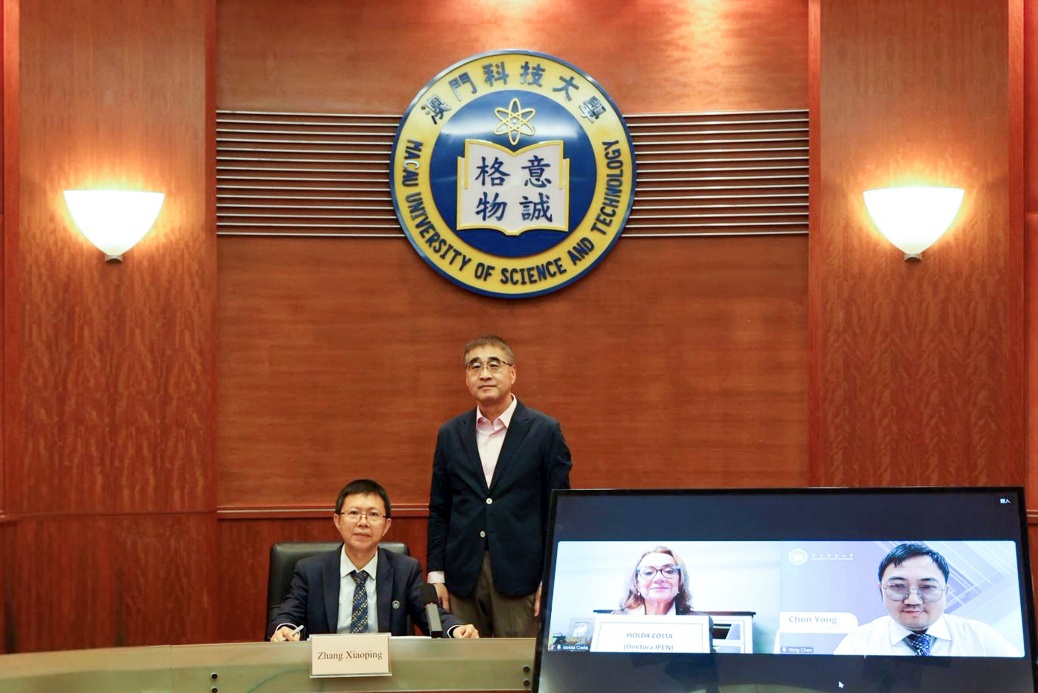
Professor Xiaoping Zhang (far left, Deputy Director of the of the State Key Laboratory of Lunar and Planetary Sciences), Director Isolda Costa of Brazil’s IPEN (on screen, left), with witnesses Chair Professor Yong Chen (Vice President of MUST, on screen, right) and Dr. Kwan Wong, Chairman of WI HARPER (Macao), at the signing of the Memorandum of Understanding.
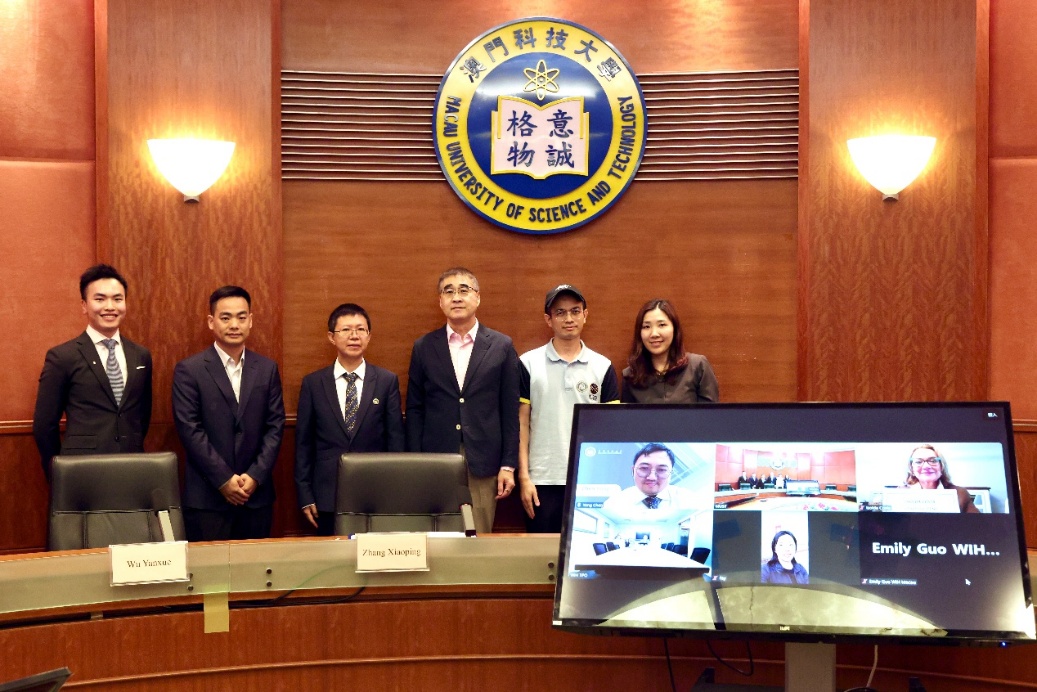
Group on‑site attendees (from left): Marco Wai, Special Assistant of WI HARPER (Macao); Associate Professor Yanxue Wu; Professor Xiaoping Zhang, Deputy Director of the State Key Laboratory of Lunar and Planetary Sciences; Dr. Kwan Wong, Chairman of WI HARPER (Macao); Assistant Professor Pengwei Luo; Cravina Chong, Secretary of the MUST President’s Office. Online participants: Chair Professor Yong Chen, MUST Vice President; Dr. Isolda Costa, Director of IPEN; Sean Peng, Senior Partner of WI HARPER Group; Kelvin Sun, Partner of WI HARPER Group; Emily Guo, Director of WI HARPER (Macao); Fay Li, Chief Operating Officer of Alpha Ring International.
The smooth rollout of this partnership stems from coordinated support across multiple stakeholders. FDCT has approved special funding to cover the introduction of the Alpha‑E device. Alpha Ring International undertakes full‑cycle delivery of the Alpha‑E system, including R&D, manufacturing, on‑site installation, commissioning and long‑term technical maintenance. WI HARPER (Macao)—granted Macau SAR’s first private equity fund license in July 2025—coordinates cross‑border resource matching and industry‑university‑research alignment. All parties have established a tight collaborative framework alongside MUST’s SKLPlanets to translate the framework agreement into tangible operational work.
This signing follows the industry‑university‑research partnership struck between MUST’s SKLPlanets and WI HARPER (Macao) back in March 2025, representing a key strategic expansion into international cutting‑edge nuclear energy research. Against the backdrop of China and Brazil jointly advancing alignment between the Belt and Road Initiative and Brazil’s national development agenda, this cross‑border collaboration is set to create a demonstration effect for frontier nuclear energy research. It also addresses national demands for nuclear energy and aerospace advancement, fuels Macau’s moderate economic diversification, and broadens models for cross‑border tech innovation cooperation within the GBA. Critically, the dual research and teaching functionality of the Alpha‑E device will enable MUST to build the first dedicated clean energy talent training and technology popularization platform serving the Greater Bay Area and Portuguese‑speaking countries. The platform will reserve international talent and accumulate original technological achievements to underpin long‑term fusion energy progress.
Moving forward, all partners will proceed in an orderly manner with installation preparations for the Alpha‑E equipment while submitting the joint FDCT‑FAPESP research application. The long‑term cross‑border industry‑university‑research collaboration will deepen steadily, targeting high‑impact research outputs in nuclear energy, aerospace and related fields. The team will also actively explore pathways for commercialization of research outcomes, positioning MUST as a vital hub bridging China and Portuguese‑speaking nations in low‑carbon energy technology and education.