

Reaching New Heights: MUST Faculty of Medicine Undergraduate Publishes High-Level Review Paper in Top-Tier Food Science Journal




Reaching New Heights: MUST Faculty of Medicine Undergraduate Publishes High-Level Review Paper in Top-Tier Food Science Journal
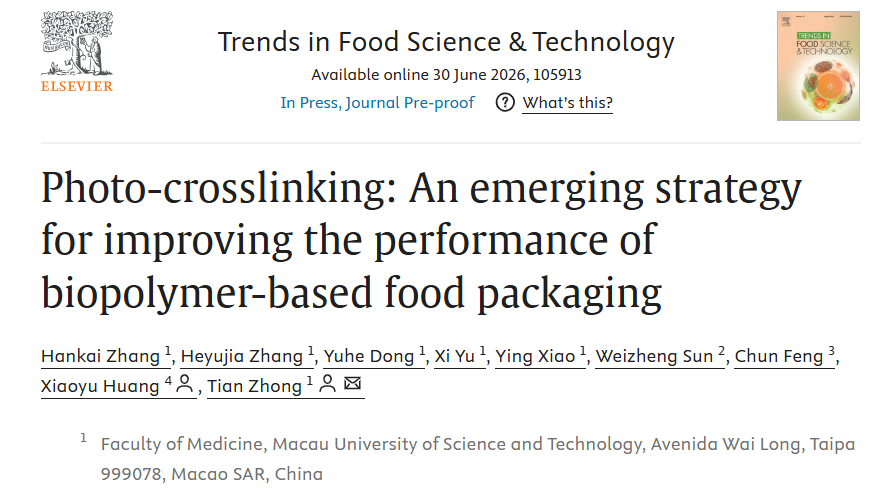
Zhang Hankai, an undergraduate student majoring in Food and Nutritional Sciences at the Faculty of Medicine, Macau University of Science and Technology (MUST), published a high-level review paper as the first author in Trends in Food Science & Technology (Impact Factor: 17.4, ranked 2/187 globally in the Food Science & Technology category by Clarivate, a top-tier Q1 journal). The paper is titled "Photo-crosslinking: An emerging strategy for improving the performance of biopolymer-based food packaging".
The Faculty of Medicine at MUST is the first institutional affiliation of the paper, and Associate Professor Zhong Tian from the Faculty of Medicine is the corresponding author. This high-impact research milestone was proudly funded and supported by the Science and Technology Development Fund of Macau (FDCT; Project Nos. 0009/2023/AFJ and 0005/2024/AGJ).
This research was driven by the urgent need to break through the “performance bottlenecks” of eco-friendly green food packaging. In response to the global urgency of plastic pollution and escalating food safety demands, natural biopolymers—predominantly proteins and polysaccharides—are rapidly emerging as vital alternatives to traditional petroleum-based plastics in food packaging. However, pristine biopolymers typically suffer from high hydrophilicity, inadequate mechanical strength, poor water resistance, and limited barrier properties. These limitations hinder their direct application in moisture prevention, antimicrobial protection, antioxidant delivery, and shelf-life extension.
Traditional modifications present clear trade-offs: chemical crosslinking often involves potentially toxic reagents, while physical treatments frequently yield unstable network structures.
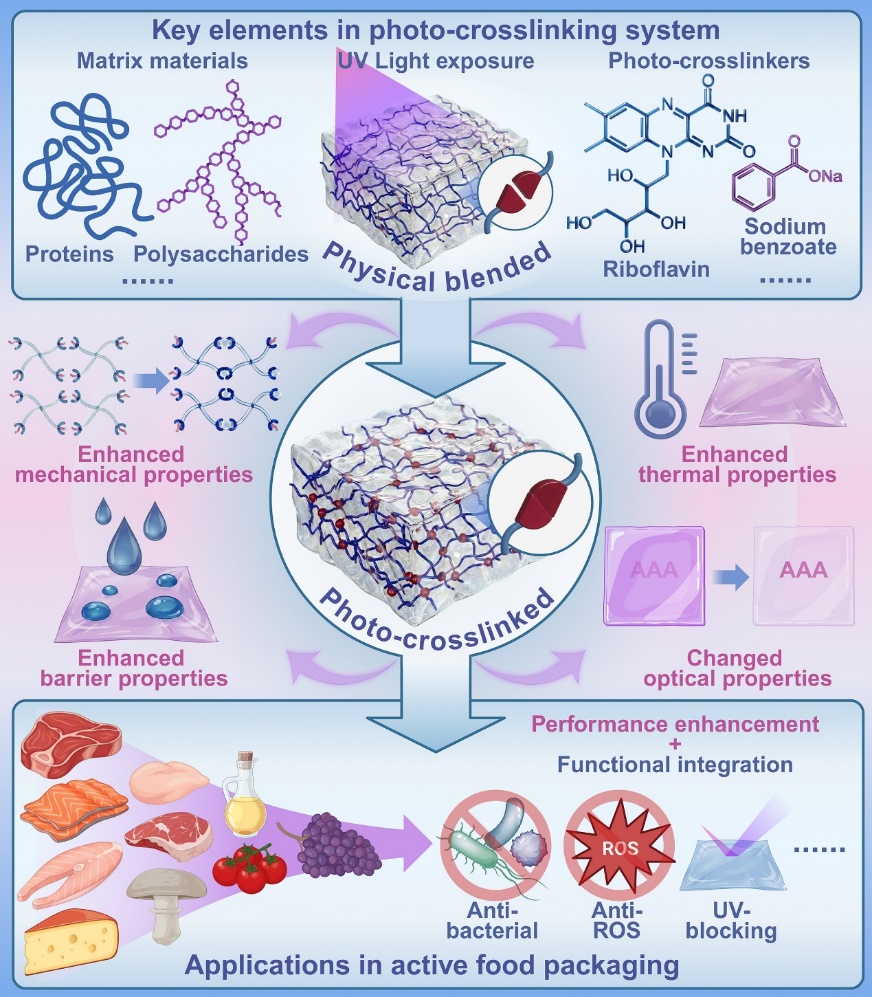
Key elements, performance enhancements, and application scenarios of photo-crosslinking in food packaging systems
Addressing these critical challenges, Zhang Hankai, under the mentorship of Associate Professor Zhong Tian, systematically reviewed the latest breakthroughs of photo-crosslinking technology in the domain of biopolymer-based food packaging films. Photo-crosslinking offers a revolutionary path toward high-performance bio-based materials owing to its rapid reaction speed, mild processing conditions, precise spatiotemporal control, low toxicity, and minimal-to-no reliance on catalysts.
The review meticulously clarifies the synergistic interactions among the light source, polymer matrix, and photo-crosslinkers: (1) Multidimensional Light Source Matching: It analyzes how ultraviolet light wavelengths (UV-A, UV-B, and UV-C) precisely match various polymer structures and photo-initiator absorption bands, while exploring the potential of visible-light systems in riboflavin and dye-sensitized frameworks. (2) Matrix Network Reconstruction: It uncovers how proteins (via oxidation-sensitive residues like tyrosine and histidine) form covalent crosslinks through free radical recombination, and how polysaccharides (such as starch, cellulose, and chitosan) achieve network restructuring through hydrogen abstraction, hydroxyl activation, or the introduction of unsaturated groups. (3) Green Safety Upgrades: It highlights that incorporating natural or food-friendly photo-sensitizers—such as riboflavin, curcumin, cinnamaldehyde, and vanillin derivatives—perfectly aligns the photo-crosslinking strategy with "clean label" standards and food-contact material safety regulations.
The photo-crosslinking seamlessly integrates "structural reinforcement" and "functional integration" within a unified material design framework. This shifts biopolymer packaging from serving as a single barrier material to becoming a multi-functional system equipped with antimicrobial, antioxidant, UV-protective, smart-responsive, and recyclable properties.

Zhang Hankai
Furthermore, the paper outlines that future research in this field will focus on refining standardization of light energy, characterizing absorption dosage along the thickness profile, monitoring the migration of residual photo-sensitizers, conducting safety risk assessments, and pioneering continuous industrial processing. With the continuous evolution of natural photo-sensitizers, reversible crosslinking networks, and on-demand release strategies, photo-crosslinking is poised to become a cornerstone technological platform for next-generation sustainable food packaging.
The publication of this high-impact paper by an undergraduate student in a world-renowned journal not only highlights the solid scientific caliber and innovative thinking of students in the Food and Nutritional Sciences program, but also stands as a shining testament to the Faculty of Medicine’s long-standing commitment to its "Research Mentorship" initiative. By encouraging undergraduates to step into top-tier laboratories and actively integrate into advanced research teams, the Faculty continues to harvest exceptional fruits in cultivating elite, innovative talents.
Full-text Link (DOI): https://doi.org/10.1016/j.tifs.2026.105913