

MUST SCSE Team Wins First Prize in National College Students IoT Design Competition


MUST SCSE Team Wins First Prize in National College Students IoT Design Competition
From August 22 to 24, 2026, the “2026 National College Students IoT Design Competition National Finals”, hosted by the National Association of Computer Education in Higher Education and undertaken by Guizhou University, was held at the West Campus of Guizhou University. The representative teams from the School of Computer Science and Engineering (SCSE), Faculty of Innovation Engineering (FIE) at Macau University of Science and Technology (MUST) delivered an outstanding overall performance. Under the careful guidance of Assistant Professor Li Nannan, Assistant Professor Mao Yuyi, and Associate Professor U Kin Tak, a total of four teams stood out. Among them, "Team MUST What You Said", "Team Ligament Guardian Experts", and "Team Lulu Youwei" won the First Prize in the National Finals, while "Team SkyStep" won the Second Prize in the East China Regional Competition.
The National College Students IoT Design Competition is advocated by the Teaching Steering Committee for Computer-related Majors in General Higher Education Institutions of the Ministry of Education and hosted by the National Association of Computer Education in Higher Education. It has been included in the "National Competition List for General Higher Education Institutions of China Higher Education Society" since 2023. The competition attracted a total of 25,260 teachers and students from 4,778 teams across 1,056 universities nationwide. After multiple rounds of selection, 273 undergraduate teams and 23 vocational college teams finally advanced to the National Finals.
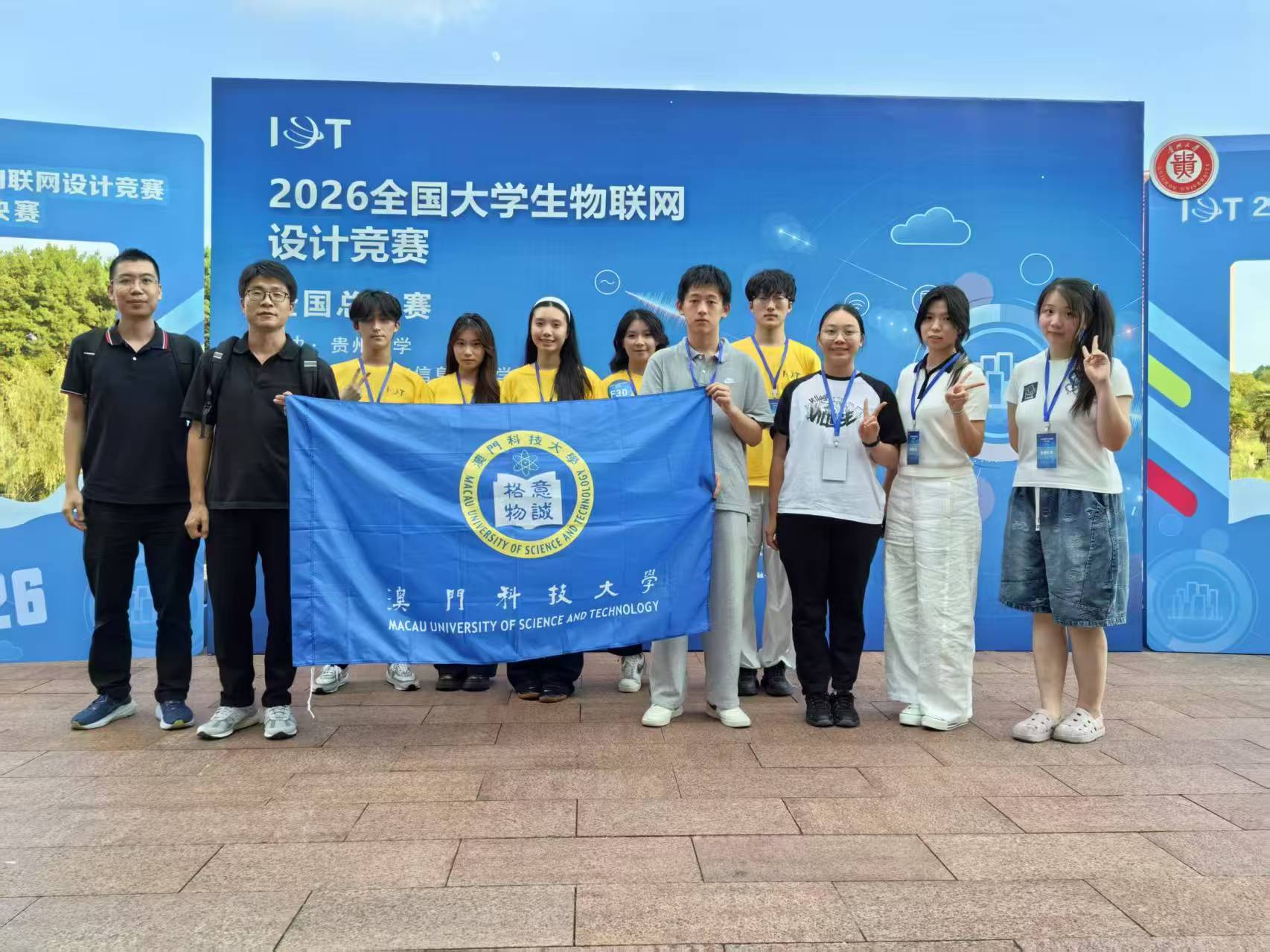
Group photo of the three winning teams with their advisors.
"Team MUST What You Said" consists of captain Zhang Xin and members He Yuanzhi, Zhang Qingyang, and Liang Ruiling. Their project is "AI Pickleball: ESP32 Multi-modal Cloud Training System". The team independently built a "Device-Edge-Cloud" collaborative architecture, deploying three data collection nodes: a body-wearable node, a racket collection node, and an off-court visual node. By integrating multi-source data such as electromyography (EMG), inertial measurement units (IMU), pressure sensors, and computer vision, the system achieves precise analysis of swing timing, shot quality, footwork posture, and ball trajectory. After the data is uploaded to the cloud, the system combines the Qwen Large Language Model to deeply analyze multi-modal information, providing real-time feedback on swing actions and personalized training reports, supporting long-term sports performance tracking and action defect positioning. The project has simultaneously developed a PC management platform and a WeChat Mini Program, which can be widely applied in scenarios such as personal training, campus teaching, club management, and competition analysis.
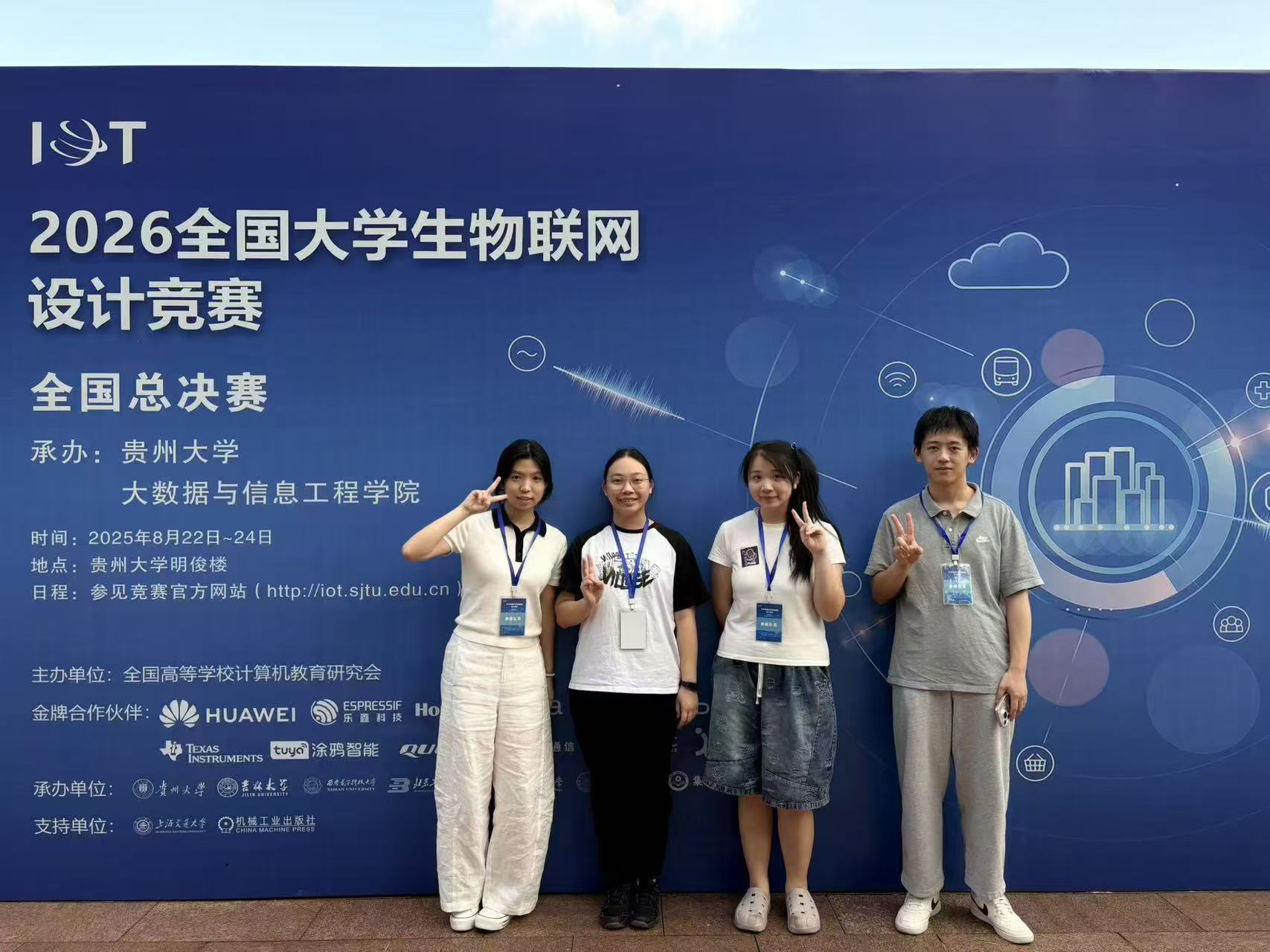
"Team MUST What You Said" (From left: He Yuanzhi, Liang Ruiling, Zhang Qingyang and Zhang Xin
"Team Ligament Guardian Experts" consists of captain Tian Nike and members Wu Yuchen and Zhang Yaoyun. Their project is "Smart Cloud Guard - Lightweight Home Precision Rehabilitation Brace". The team independently developed a lightweight wearable exoskeleton device, integrating dual-node IMU posture sensing, electromagnetic lock auxiliary braking, and edge computing decision modules to build a closed-loop control system of "perception-decision-execution-feedback". The brace first completes professional evaluation and parameter calibration in medical institutions, and then supports patients in home rehabilitation training, with training data transmitted back to the cloud in real time. Based on the data, the system dynamically optimizes personalized rehabilitation plans, effectively promoting the extension and coverage of in-hospital professional guidance to home precision rehabilitation.
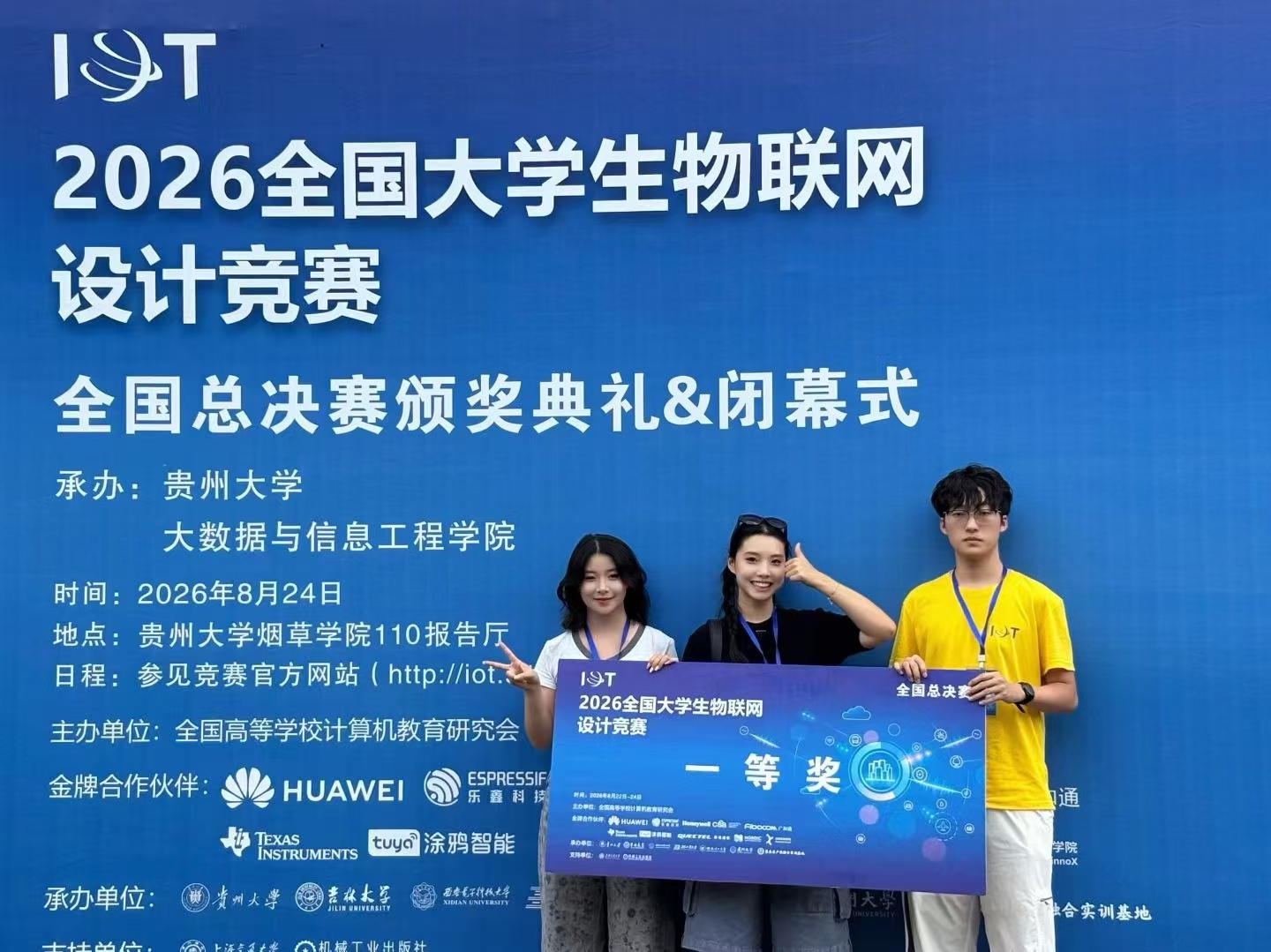
"Team Ligament Guardian Experts" (From left: Wu Yuchen, Tian Nike and Zhang Yaoyun)
"Team Lulu Youwei" consists of captain Tan Hongqing and member Yin Yuting. Their project is "AIDBOX AI Creative Printer". Aimed at children aged 3 to 12, the product connects the entire process of "voice/touch input - AI image generation - screen preview - physical printing". The device uses the ESP32-S3 microcontroller as its core, integrating NFC (Near Field Communication) and a 300 DPI thermal printing module. Children can describe their ideas via voice, and the AI will automatically generate exclusive line drawings and print them out instantly. The accompanying WeChat Mini Program supports cloud storage of works and parental monitoring functions, balancing creative fun and usage safety.
At the National Finals, the three teams competed with outstanding teams from universities across the country. Relying on solid IoT technical skills, innovative design concepts closely aligned with industry needs, as well as clear and fluent on-site demonstrations and defense performances, they fully demonstrated the technical feasibility and application value of their projects, receiving high recognition from the judging panel. The excellent results achieved by the four teams are a vivid reflection of the SCSE at MUST continuously deepening innovation and entrepreneurship education. In the future, the School will further promote university-enterprise cooperation, improve project incubation and achievement transformation mechanisms, and help students serve society with innovative achievements.