

Samuel C.C. Ting, Doctor of Science honoris causa
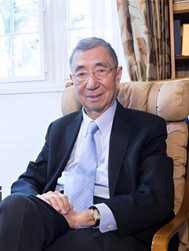
Samuel C. C. Ting is a globally renowned physicist and Nobel laureate who has made groundbreaking contributions to the field of experimental particle physics and astrophysics. In 1974, Ting discovered a new form of matter and named it the“J particle.”This research integrated existing particle physics theories, which is referred to as the“November Revolution”in the field of particle physics. In 1976, Ting was awarded the Nobel Prize in Physics for his discovery of the J particle.
Samuel C. C. Ting pursued his undergraduate studies in the Physics and Mathematics departments at the University of Michigan in the United States. In 1959, he obtained a Bachelor's degree in Physics and Mathematics. In 1960, he earned a Master's degree in Physics, and in 1962, he completed his Ph.D. in Physics at the University of Michigan.
Currently, Ting holds a faculty position as a chair professor at the Massachusetts Institute of Technology (MIT) in the United States. He has long been leading international teams of experts in experimental exploration at the European Organization for Nuclear Research (CERN) in Geneva, Switzerland. His research experience focuses on conducting experiments in particle physics in accelerators and on the space station.
Ting’s academic research achievements are remarkable. He has been elected as a fellow of various esteemed institutions, including the American Academy of Arts and Sciences (1975), Academia Sinica in Taiwan (1976), the National Academy of Sciences in the United States (1977), the Pakistan Academy of Sciences as a foreign member (1983), the USSR Academy of Science as a foreign member (1988), the Hungarian Academy of Sciences as a foreign member (1993), the Chinese Academy of Sciences as a foreign member (1994), the Russian Academy of Sciences as a foreign member (1995), the Deutsche Academy Naturforscher Leopoldina of Germany as a member (1996), the Royal Spanish Academy of Science as a foreign member (2003), and an honorary fellow of the Tata Institute of Fundamental Research in Mumbai, India (2004).
In addition to his Nobel Prize for Physics, Ting has also received several other prestigious awards, including the Ernest Orlando Lawrence Award U.S. government (1976), the Eringen Medal from the Society of Engineering Sciences of the United States (1977), the DeGaspari Award in Science from the Government of Italy (1988), the Gold Medal for Science from Brescia, Italy (1988), and the NASA Public Service Medal (2001), among many others.