

丁肇中 榮譽理學博士
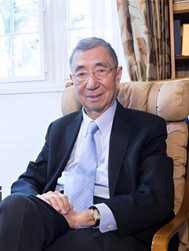
丁肇中(Samuel C. C. Ting)是享譽全球的傑出物理學家和諾貝爾物理獎得主,在實驗粒子物理學領域和天體物理學領域具有開創性的貢獻。1974年,丁肇中發現了新的物質形態並將其命名爲“J粒子”。這項研究整合了原有的粒子物理理論,學界稱之為粒子物理學的“11月革命”。1976年,丁肇中因發現J粒子而榮獲當年的諾貝爾物理獎。
丁肇中大學就讀於美國密西根大學物理系、數學系,1959年獲得物理與數學學士學位,1960年獲物理碩士學位,1962年於美國密西根大學物理系獲得物理博士學位。丁院士現任美國麻省理工學院講座教授,長期在瑞士日內瓦的歐洲核子研究中心(CERN)帶領國際專家團隊進行實驗探索,其研究經歷聚焦於在加速器上和空間站上主持粒子物理實驗。
丁院士學術研究成果斐然,先後獲選美國藝術與科學院院士(1975)、中央研究院院士(1976)、美國國家科學院院士(1977)、巴基斯坦科學院外籍院士(1983)、蘇聯科學院外籍院士(1988)、匈牙利科學院外籍院士(1993)、中國科學院外籍院士(1994)、俄羅斯科學院外籍院士(1995)、德國科學院院士(1996)、西班牙科學院外籍院士(2003)、印度TATA研究院榮譽院士(2004)。除諾貝爾物理獎的殊榮之外,丁院士還榮膺美國政府Ernest Orlando Lawrence獎(1976),美國工程科學學會Eringen獎(1977)、意大利政府DeGaspari科學獎(1988)、意大利Gold Medal 科學獎(1988)、美國宇航局公共服務獎(2001)等諸多獎項。
Samuel C.C.Ting
Samuel C. C. Ting is a globally renowned physicist and Nobel laureate who has made groundbreaking contributions to the field of experimental particle physics and astrophysics. In 1974, Ting discovered a new form of matter and named it the“J particle.”This research integrated existing particle physics theories, which is referred to as the“November Revolution”in the field of particle physics. In 1976, Ting was awarded the Nobel Prize in Physics for his discovery of the J particle.
Samuel C. C. Ting pursued his undergraduate studies in the Physics and Mathematics departments at the University of Michigan in the United States. In 1959, he obtained a Bachelor's degree in Physics and Mathematics. In 1960, he earned a Master's degree in Physics, and in 1962, he completed his Ph.D. in Physics at the University of Michigan.
Currently, Ting holds a faculty position as a chair professor at the Massachusetts Institute of Technology (MIT) in the United States. He has long been leading international teams of experts in experimental exploration at the European Organization for Nuclear Research (CERN) in Geneva, Switzerland. His research experience focuses on conducting experiments in particle physics in accelerators and on the space station.
Ting’s academic research achievements are remarkable. He has been elected as a fellow of various esteemed institutions, including the American Academy of Arts and Sciences (1975), Academia Sinica in Taiwan (1976), the National Academy of Sciences in the United States (1977), the Pakistan Academy of Sciences as a foreign member (1983), the USSR Academy of Science as a foreign member (1988), the Hungarian Academy of Sciences as a foreign member (1993), the Chinese Academy of Sciences as a foreign member (1994), the Russian Academy of Sciences as a foreign member (1995), the Deutsche Academy Naturforscher Leopoldina of Germany as a member (1996), the Royal Spanish Academy of Science as a foreign member (2003), and an honorary fellow of the Tata Institute of Fundamental Research in Mumbai, India (2004).
In addition to his Nobel Prize for Physics, Ting has also received several other prestigious awards, including the Ernest Orlando Lawrence Award U.S. government (1976), the Eringen Medal from the Society of Engineering Sciences of the United States (1977), the DeGaspari Award in Science from the Government of Italy (1988), the Gold Medal for Science from Brescia, Italy (1988), and the NASA Public Service Medal (2001), among many others.