

MUST School of Computer Science and Engineering Makes a Series of Advances in Quantum Diffusion Models




MUST School of Computer Science and Engineering Makes a Series of Advances in Quantum Diffusion Models
Recently, the School of Computer Science and Engineering at Macau University of Science and Technology (MUST) has made two significant advances in quantum machine learning. Two papers, both with PhD student Chen Chuangtao as first author and Professor Zhao Qinglin as corresponding author, were accepted by IEEE Transactions on Pattern Analysis and Machine Intelligence (TPAMI) and published in the Nature Portfolio journal npj Quantum Information, respectively. With MUST as the lead institution, one study develops a quantum approach to generating complex quantum states, while the other uses quantum computing to capture relationships across high-dimensional discrete data. Together, the two studies open new avenues at the intersection of quantum computing and generative artificial intelligence.

Ph.D. student Chen Chuangtao, first author (left), and Professor Zhao Qinglin, corresponding author (right).
The first study, which focuses on quantum-state generation, has been formally accepted by TPAMI, a leading international journal in artificial intelligence. Established by the IEEE Computer Society in 1979, TPAMI is a flagship journal in machine learning and machine intelligence; it has consistently ranked among the top 2% of journals in the “Computer Science, Artificial Intelligence” category, has a current impact factor of 20.4, and is listed as a CAS Zone 1 TOP journal and a CCF Class A journal. The paper is entitled “Quantum Generative Diffusion Model: A Fully Quantum-Mechanical Model for Generating Quantum State Ensemble.” The study aims to teach quantum computers to generate collections of quantum states that follow a desired pattern.
In real quantum devices, interactions with the environment and hardware noise often leave a system in a mixture of possible states rather than a single ideal state. Generating such mixed states reliably is challenging. The team therefore developed the Quantum Generative Diffusion Model (QGDM), which learns to recover a target quantum state after progressively disturbing it. Reusing model parameters keeps the model compact, while a resource-efficient variant further reduces the quantum resources required. The researchers also examined how the degree of mixing, the number of processing steps, and the required number of qubits are related. Their architecture is designed to prevent the model from taking a shortcut by merely copying the input during training. Simulations show that QGDM can generate several types of quantum states, including random pure states, mixed states, and thermal equilibrium states of the transverse-field Ising model. Fidelity measures how closely a generated state matches its target. On mixed-state tasks, QGDM and its resource-efficient variant achieved an average best fidelity 53.02% higher than that of the quantum generative adversarial network baseline. Under noisy conditions, they also achieved the highest average fidelity among all methods compared.
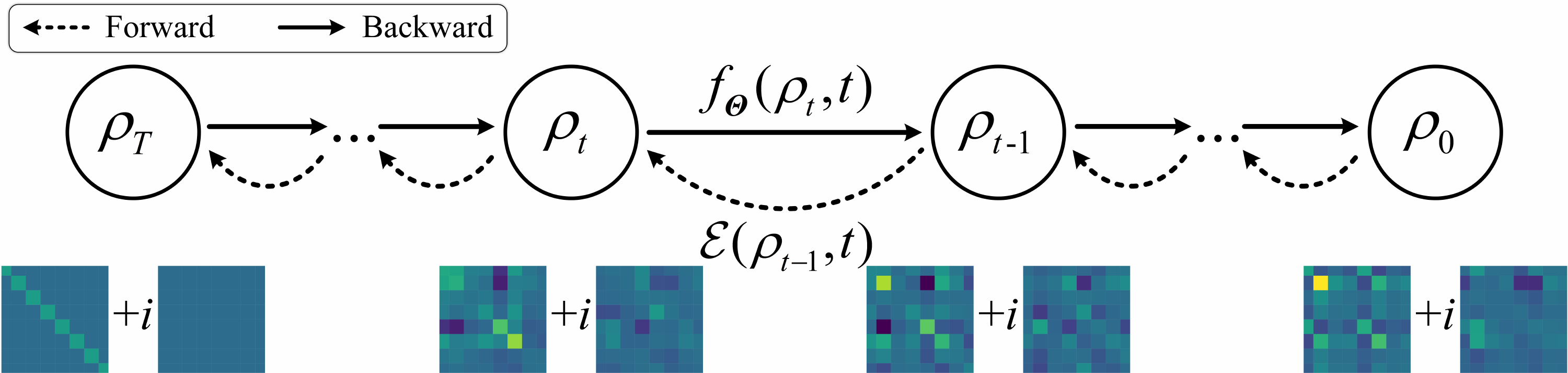
Overall architecture of QGDM. The model gradually perturbs a target quantum state and then learns to recover it through a trainable quantum process.
The second study, which focuses on discrete data generation, was published in npj Quantum Information, a Nature Portfolio journal. The journal is one of the most influential in quantum information, covering cutting-edge research in quantum computing, quantum information theory, and related areas; it has a current impact factor of 9.0 and ranks third in the “Quantum Science and Technology” category. The paper is entitled “Overcoming Dimensional Factorization Limits in Discrete Diffusion Models through Quantum Joint Distribution Learning.” The study addresses a key challenge in complex data modeling: preserving important relationships among different data features. The work was also selected for an invited presentation at the Doctoral Forum of the CCF Quantum Computing Conference, further highlighting its novelty and academic value.
To reduce computational cost, existing discrete diffusion models often process different data features separately, which can weaken or lose the relationships between them. The team proved that, for strongly correlated data, the worst-case fitting error of such methods grows in proportion to the number of dimensions. To overcome this limitation, they developed the Quantum Discrete Denoising Diffusion Probabilistic Model (QD3PM), which uses quantum computing to learn how all features are related as a whole rather than treating them independently. The model can reuse the same parameters, generate samples in a single step, and produce data under specified conditions without retraining. Experiments on Gaussian-mixture and striped-data tasks with up to 10 qubits show that QD3PM preserves relationships among data features more effectively and achieves lower fitting errors than classical methods of comparable size. It also remains more stable than other quantum generative models in the presence of quantum noise.
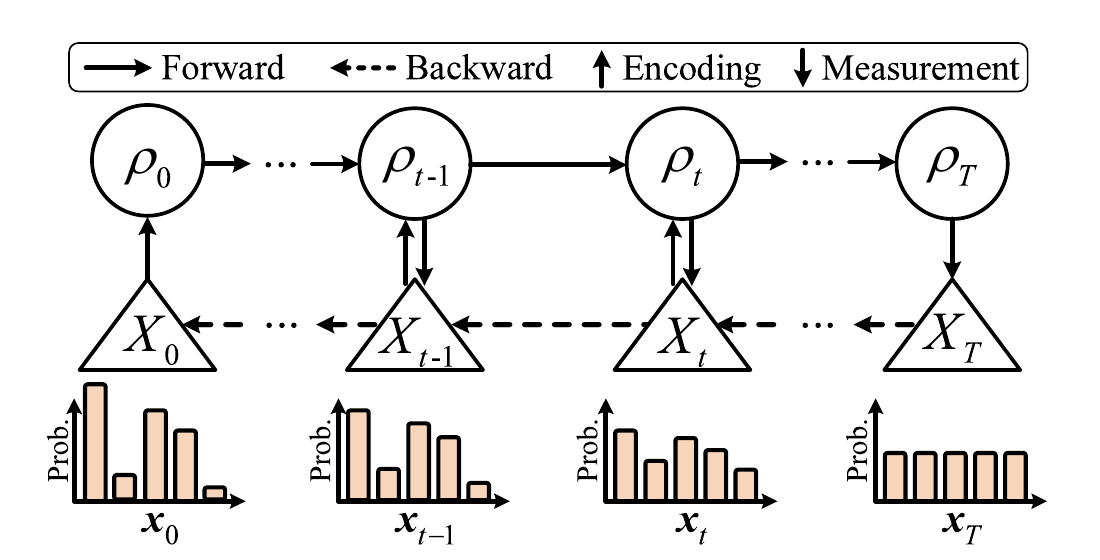
Overall architecture of QD3PM. The model preserves relationships among data features and generates discrete data through a gradual process of adding and removing noise.
Both studies were first-authored by PhD student Chen Chuangtao from the School of Computer Science and Engineering, with Professor Zhao Qinglin as corresponding author; the other co-authors are MengChu Zhou, Dusit Niyato, Zhimin He, Zhili Sun, and Haozhen Situ. Together, the two studies advance two complementary areas. One focuses on complex quantum-state generation, while the other explores the quantum-enhanced generation of classical discrete data. The findings broaden the theoretical scope and application potential of quantum diffusion models and highlight MUST’s continued strength in interdisciplinary research and the training of high-caliber researchers.
The research was generously supported by the Science and Technology Development Fund, Macao SAR.
Paper links:
1. TPAMI paper: https://doi.org/10.1109/TPAMI.2026.3718311
2. npj Quantum Information paper: https://doi.org/10.1038/s41534-026-01188-0