

Generating Multi-Omics Profiles from Routine Clinical Data: MUST Develops PULSE Framework to Advance AI-Enabled Precision Medicine for All




Generating Multi-Omics Profiles from Routine Clinical Data: MUST Develops PULSE Framework to Advance AI-Enabled Precision Medicine for All
A research team led by Professor Kang Zhang of the Artificial Intelligence Cross Disciplinary Research Institute (AI-X) and the Faculty of Medicine at Macau University of Science and Technology (MUST), in collaboration with Wenzhou Medical University, Guangzhou Laboratory, Peking University, the International Medical Digital Twin Alliance, and other research and clinical institutions in China and abroad, has published a research article in the leading international journal Nature Computational Science. The study introduces the Patient Unified Longitudinal Signal Engine (PULSE), a framework that tracks longitudinal changes in patients’ routine blood tests to accurately infer costly and difficult-to-repeat metabolomic and proteomic profiles. By enabling precision medicine to move beyond resource-intensive research settings into primary care and resource-limited regions, PULSE has the potential to substantially reduce healthcare costs and promote health equity.
High-dimensional molecular profiling, including metabolomics and proteomics, can reveal deep insights into an individual’s health and disease states and form an important foundation of precision medicine. However, these tests are expensive, technically complex, and, in some cases, relatively invasive, making frequent testing impractical in routine clinical care. In sharp contrast, basic laboratory tests such as complete blood counts and blood chemistry panels are inexpensive, minimally invasive, readily repeatable, and among the most commonly collected data in clinical follow-up.
This raises a fundamental scientific question: Can the evolving physiological trajectories recorded through repeated routine clinical tests be used to infer changes in molecular profiles that are costly and difficult to measure repeatedly?
Professor Zhang’s team showed that the answer is yes.
This is the central insight behind the PULSE framework. Repeated clinical encounters from the same patient form a longitudinal multimodal dataset. Information lies not only in the relationships among different laboratory measurements within a single visit, but, more importantly, in how these measurements change across time. In other words, the true value of a routine laboratory result can only be fully realized when it is interpreted in the longitudinal context of the patient’s previous measurements.
Based on this concept, PULSE explicitly encodes a personalized latent state from a patient’s preceding visit and carries it forward to the current encounter. This historical representation is then aligned and integrated with the sparse routine laboratory data obtained at the current visit within a shared latent space, enabling reconstruction of a complete, high-dimensional molecular profile for the current time point. Put simply, PULSE enables every routine blood test to come with a virtual high-throughput omics report.
The research team systematically validated the effectiveness of this strategy in large-scale cohorts. In the task of generating 251 metabolomic biomarkers from 61 routine blood test variables, PULSE achieved significantly higher predictive performance than all benchmark methods. Particularly noteworthy was its greater accuracy in predicting metabolites under tighter physiological homeostatic control, suggesting that PULSE captures biologically meaningful physiological regulation rather than merely performing statistical interpolation.
In the proteomic profile generation task, PULSE integrated routine laboratory measurements with medical history information from electronic health records to generate proteomic profiles that closely matched experimentally measured proteomic data. Disease prediction models trained on the generated proteomic profiles achieved areas under the receiver operating characteristic curve comparable to those of models based on costly measured proteomic profiles across six common age-related diseases. This suggests that patients may obtain molecular signals sufficiently informative for precision risk assessment without having to undergo expensive proteomic testing.
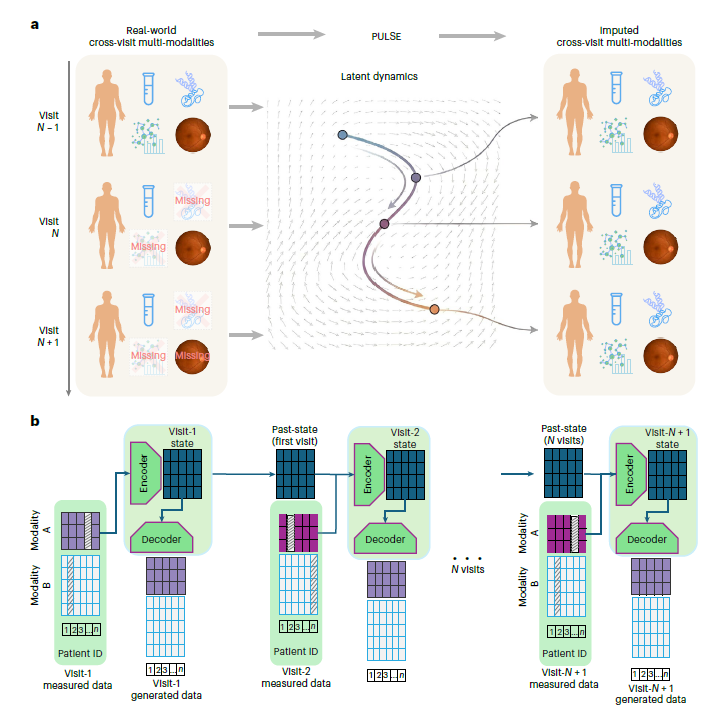
The PULSE framework
The research team further uncovered deeper biological structures encoded within the PULSE latent space. Through trajectory inference in the joint latent space of study participants, the researchers found that individuals did not progress along a single uniform ageing pathway, but instead diverged into three distinct ageing trajectories. Individuals following one of these trajectories showed significantly higher cumulative incidences of age-related diseases, including chronic obstructive pulmonary disease, diabetes, heart failure, and stroke, compared with people of the same age, indicating an “accelerated ageing” trajectory.
The core idea of PULSE is to use inexpensive, repeatable routine tests to ‘track’ changes in costly molecular measurements that are difficult to repeat,” Professor Kang Zhang said. “We use the large-scale multimodal databases that we have invested substantial resources in building as a ‘training ground’, allowing the model to learn this inferential capability. We can then bring that capability to primary-care hospitals and remote regions, where research-grade testing facilities may not be available but routine blood and laboratory testing capabilities are widely accessible. PULSE enables everyone to obtain health assessments approaching the level of precision medicine at very low cost.”
The significance of the study extends beyond a technological breakthrough. It also lies in its potential to advance global health equity. In a world where healthcare resources remain unevenly distributed, PULSE could enable patients in primary-care and underserved regions to obtain rich molecular profiles from routine laboratory tests alone, without travelling long distances or paying prohibitively high costs, thereby supporting early risk identification and early warning of disease. This is the core value of the “measure less, infer more” concept: extracting the greatest possible amount of health information from the least amount of testing and transforming precision medicine from a “luxury” into an accessible part of everyday healthcare.
As the PULSE framework continues to evolve, the “measure less, infer more” paradigm may reshape clinical decision-making pathways, turning every routine blood draw into a step toward precision health management and enabling advances in medical technology to benefit people everywhere.
Article link: https://doi.org/10.1038/s43588-026-01026-5