

MUST Doctoral Students from the School of Computer Science and Engineering Publish a High-Quality Survey Paper in a Top Journal in the Field of Internet of Things




MUST Doctoral Students from the School of Computer Science and Engineering Publish a High-Quality Survey Paper in a Top Journal in the Field of Internet of Things
On June 10, 2026, PhD students from the School of Computer Science and Engineering of Faculty of Innovation Engineering at Macau University of Science and Technology (MUST) published a review paper entitled “Towards Wearable Sensor-based Human Activity Recognition: A Survey” in the top journal in the field of Internet of Things (IoT), IEEE Internet of Things Journal (IOTJ). The journal has an impact factor 8.9 and ranked 11th out of 258 in the Computer Science and Information Systems category by Clarivate Analytics.
This work was independently completed by the MUST team. Dr. Hailin Zou, a 2021 PhD student in the PhD in Artificial Intelligence, is the first author, and Dr. Zijie Chen, a 2022 PhD student in the PhD in Science, is a co-first author. Professor Jianqing Li is the corresponding author, and Assistant Professor Yuanyuan Pan participated in the related research. The main work of this paper is the research result of the two PhD students during their studies at the university, and the process from submission to publication took more than two years.
According to incomplete statistics based on publicly available information, survey papers published in IOTJ over the past five years account for only about 2% of the journal’s total publications, indicating an extremely rigorous selection process. This fully demonstrates the academic value of this achievement and the international academic influence of MUST in interdisciplinary research areas including artificial intelligence, wearable sensing, and the Internet of Things. This research was supported by the Guangdong-Hong Kong-Macao Joint Laboratory for Intelligent Micro-Nano Optoelectronic Technology (2020B1212030010) and the Macao Science and Technology Development Fund project (0040/2024/RIA1).
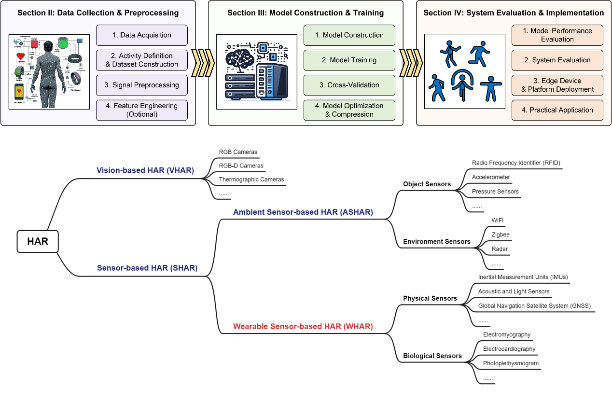
Life cycle of wearable sensor-based human activity recognition systems and taxonomy of HAR
This survey focuses on Wearable Sensor-based Human Activity Recognition (WHAR). Centered on the complete life cycle of WHAR systems, it provides a systematic review covering data acquisition and preprocessing, model construction and training, system evaluation, and real-world deployment. The paper not only summarizes mainstream supervised learning models and emerging learning paradigms, but also analyzes the intrinsic connections among different stages from the perspectives of sensor configuration, learning method selection, evaluation criteria, and deployment constraints. It further clarifies the classification boundaries among vision-based, ambient sensor-based, and wearable sensor-based human activity recognition. This study provides a valuable design framework for building accurate, efficient, and deployable intelligent wearable sensing systems. For more details about the paper, please visit https://doi.org/10.1109/JIOT.2026.3702134 .