

MUST-PRMRC Professor Xinghua Pan’s Research Team Has Released Important Discoveries in the Nature family journal STTT, Uncovering a Novel Mechanism Underlying Chronic Liver‑Disease‑Related Hepatic Fibrosis




MUST-PRMRC Professor Xinghua Pan’s Research Team Has Released Important Discoveries in the Nature family journal STTT, Uncovering a Novel Mechanism Underlying Chronic Liver‑Disease‑Related Hepatic Fibrosis
Recently, the research team led by Professor Xinghua Pan from the Precision Regenerative Medicine Research Centre (PRMRC), Medical Sciences Division, Macau University of Science and Technology (MUST), has collaborated with the team led by Professor Hui Liu from Guangzhou Medical University and other research institutions and published important research achievements in Signal Transduction and Targeted Therapy (Nature journal STTT, IF = 81.197, CAS Journal Top‑Tier, Q1). The study elucidates the roles and molecular mechanisms of Mallory‑Denk bodies (MDBs) in liver diseases and identifies the HGF/MET/UbD signalling axis underlying, offering promising new potential therapeutic targets for chronic liver diseases.
MDBs are characteristic cytoplasmic protein inclusions in chronic liver diseases, frequently detected in specimens of steatohepatitis, hepatic fibrosis and hepatocellular carcinoma.
Leveraging single‑nucleus RNA sequencing (snRNA‑seq), together with multi‑level validations using a self‑established 3D MDB organoid model, UbD‑knockout mice and human clinical liver biopsy samples, the study yields a series of innovative findings.
The research team identifies MDB‑associated hepatocytes (MAHs), a hepatocyte subpopulation closely linked to hepatocellular carcinoma progression, and confirms that activated hepatic stellate cells (aHSCs) serve as key effector cells driving pathological lesions.
The study also reveals the forming of a pathological positive‑feedback loop HGF‑MET‑UbD‑TNFα that promotes MDB biogenesis in hepatocytes, which further exacerbate liver fibrosis. In‑vivo mouse and human liver biopsy samples experiments, verify significant hyper‑activation of this signalling axis in MDB‑positive pathological tissues, and block HGF–MET–UbD–TNFα pathway effectively suppresses the vicious cycle, underscoring the clinical applicability and translational potential of these findings.
The full‑length article is entitled “Unraveling the HGF/MET axis in Mallory‑Denk body pathogenesis associated with liver fibrosis through single‑cell transcriptomics”. Professor Hui Liu from Guangzhou Medical University is the lead corresponding author, and Professor Xinghua Pan from Macau University of Science and Technology serves as co‑corresponding author. This research was supported by the National Key Research and Development Programme of China, the National Natural Science Foundation of China, and the Macao Science and Technology Development Fund.
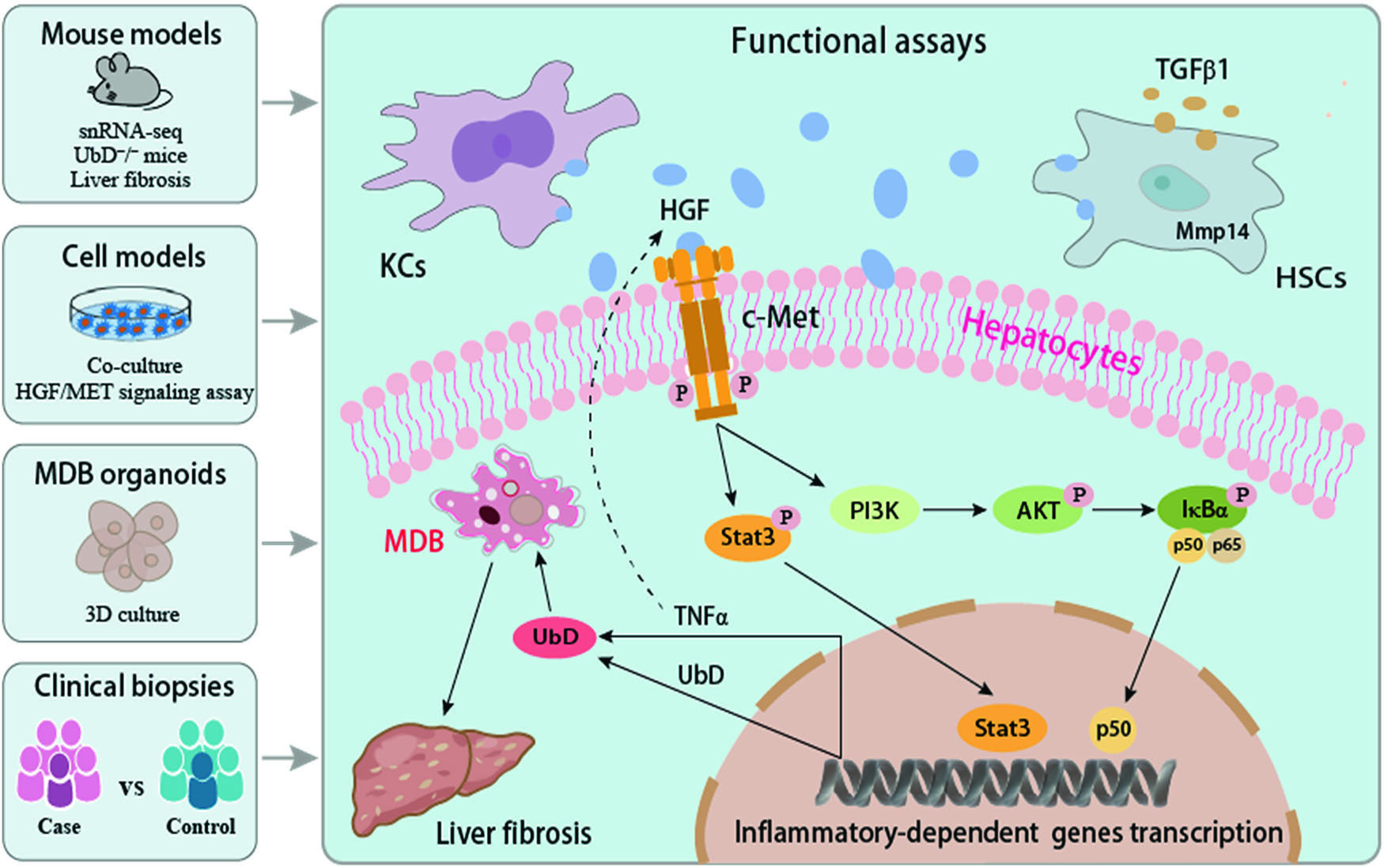
Figure legend: Schematic diagram illustrating how the HGF/MET/UbD axis mediates MDB formation and hepatic fibrosis (Figure 8 from the original article)
Professor Xinghua Pan with his team has long been devoted to single‑cell omics research. The group conducts multi‑omics mechanistic investigations into liver diseases and leukaemia, constructs diagnostic‑therapeutic models, and develops mutation‑detection assays for single cells and trace‑amount cells. Under the leadership of Chair Professor Paul Kwong-Hang Tam, PRMRC focuses research on hepatic fibrosis, its prevention and management, as well as the mechanisms and technologies promoting liver regeneration. This reported work completes a rigorous research pipeline of “omics discovery ‑ in‑vitro organoid modelling ‑ animal experiments ‑ clinical‑sample validation”, holding great value for translational medicine. Moving forward, the team will carry out artificial‑intelligence‑assisted cohort studies and targeted‑intervention research to advance the clinical translation of therapeutic strategies for liver diseases.
The article link: https://www.nature.com/articles/s41392-026-02722-4