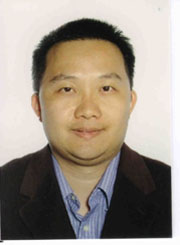
Assistant Professor Liang, ZhiyaoSchool of Computer Science and Engineering, Faculty of Innovation Engineering Macau University of Science and Technology
Office: A216 Tel.: +853-8897 2940 E-mail: [email protected] |
| Academic Qualification: |
|
| Teaching Area |
|
| Research Area |
|
| Working Experience |
|
|
Academic Publication (Selected) |
|
| Professional Certification and Awards |
|
Sun Certified Java Programmer |
| Professional Society Membership |
|
Member of IEEE, 2005 to present |

Introduction
The Institute for Sustainable Development, Macau University of Science and Technology, established in September 2002, conducts a range of economic, social and public policies related to Macao on the premise that they are “neutral, scientific and constructive”. For instance, they develop and publish indexes and special studies closely associated with current social and economic development of Macao and neighboring areas. In addition, it undertakes policy consultations and surveys entrusted by government departments of the Special Administrative Region, and carry out public opinion or market surveys for different industries. Besides, the institute has established stable cooperative relationships with several scientific research institutes. It gets involved in studying national and regional research topics.
It has a Computer Assisted Telephone Interview (CATI) for market surveys and capable teams for surveys, interviews and superintendence. It regularly published several important indicators of Macao, including Macao Consumer Confidence Index (CCI), Macao-Zhuhai Consumer Satisfaction Index (CSI) and Macao Employee Confidence Index (ECI) for over 10 consecutive years. Since the first quarter of 2009, it has cooperatively published cross-strait, Hong Kong and Macao consumer confidence indexes, continuously tracked and promptly fed back consumers’ confidence about social economy. It has progressively become a research brand with certain awareness and influence. Since 2012, it has cooperatively studied and published urban competitiveness of Macao in the “reports on urban competitiveness in China” together with the Urban and Competitiveness Research Center, Chinese Academy of Social Sciences.
Based on project research, the institute invites experts inside and outside to jointly study research topics of several fields, including society, economy, people’s livelihood, environment and energy. The studies carried out by the institute include longitudinal topics funded by Macao Foundation, Science and Technology Development Fund and National Natural Science Foundation of China (NSFC) as well as horizontal topics entrusted by government departments, financial institutions and communities of the Special Administrative Region.
Through market surveys, the institute has cultivated a group of local Macao students as investigators with practical experiences. Meanwhile, it attracts postgraduates and Ph.D. students to participate in research, in order to enhance their empirical research capabilities. In the 2020/2021 academic year, the Institute had launched the “Ph.D. Program in Urban and Regional Economics”, in hope of fostering more talents for related fields.
It actively holds diverse exchanges and cooperation with different circles of the society. It assembles experts and scholars at lectures on “sustainable development” and “financial/economic forums of the bay area” to introduce advanced theories and economic practices to students, so as to expand their field of vision.
At present, the institute is actively conducting research on regional economy. According to the national plan for Guangdong-Hong Kong-Macao Great Bay Area, it will construct urban and regional science teaching bases, create high-end think tanks on urban and regional development, and build collaborative innovation platforms to integrate disciplines, resources and interactions.
Copyright © 2011-2025 The Macau University of Science and Technology.
All rights reserved.
All rights reserved.
Tel.: (853) 2888 1122
Fax: (853) 2888 0022
Fax: (853) 2888 0022
Address: Avenida Wai Long, Taipa, Macau, China